Affichage des articles dont le libellé est Gnosticism. Afficher tous les articles

dimanche 23 juin 2024

Gnostic Pointing-Out Instructions on Pure Light

Imperial Passport, Universal Seal "mahāmudrā"

The Secret Book of John/The Apocryphon of John  (BG, 2 ; NH III, 1) is an early Christian (Gnostic) dialogue between Jesus and his “favorite disciple” John. John’s vision of Jesus will introduce John into the knowledge needed to escape the limitations of the material world and to reunite with the higher realm from which he came. That is, the most essential and pure part of “John”, his part of the divine, his soul or higher Self we could say.

Jesus appears as a young man and an old man “in whom Light was present”). Jesus says to John:
I am with you (plural) always.
I am the Father
The Mother
The Son
I am the incorruptible
Purity
[1].”
Jesus then goes on to introduce John into the knowledge (gnosis) of the origination of all things, and explains the “Monade” or “the One”, “that rules all” and over which “nothing has authority”, a “monarchy” (BB).
It is uncontaminated
Pure light no eye can bear to look within.
The One is the Invisible Spirit [Esprit].
It is not right to think of it as a God or as like God.
It is more than just God.
Nothing is above it.
Nothing rules it.
Since everything exists within it
It does not exist within anything.
Since it is not dependent on anything
It is eternal.

It is absolutely complete and so needs nothing.
It is utterly perfect
Light
.”
The authors of the Secret Book of John were early Christians (Gnostics), with Sethian elements, and who identified with “the immovable race and the seed of Seth[2]”. They believed in what could be called a soul and in the survival of a soul after death. The “souls” can be "given over to the powers created by the rulers (archons), bound in chains, and cast into prison again". Until the liberating spiritual knowledge (gnosis) is found. The archons try to trap the divine spark within humans and keep them from gnosis.

The One, the Monad, the Invisible Spirit, “the Light” is “more than God”. God” is a lower reality of “the Light”. Our own created or emanated “reality” is a lower and impure, “contaminated reality”, including causality and all the natural laws. Everything is like sealed by the One, carrying the Seal of the One. When a divine spark leaves its temporal lower prison at the moment of death, it can be reunited with higher realms (the Kingdom, the Monarchy,...), nearer to the One, and the Light. Jesus tells John how this is possible and gives him the required gnosis. (25,3-14)
The One is without boundaries
Nothing exists outside of it to border it
The One cannot be investigated
Nothing exists apart from it to investigate it
The One cannot be measured
Nothing exists external to it to measure it

The One cannot be seen
For no one can envision it
The One is eternal
For it exists forever
The One is inconceivable
For no one can comprehend it
The One is indescribable
For no one can put any words to it.

The One is infinite light
Purity
Holiness
Stainless, (23,15-24,9)

The One is incomprehensible
Perfectly free from corruption.
Not “perfect”
Not “blessed”
Not “divine”
But superior to such concepts.
Neither physical nor unphysical
Neither immense nor infinitesimal
It is impossible to specify in quantity or quality
For it is beyond knowledge.

The One is not a being among other beings
It is vastly superior
But it is not “superior.”

It is outside of realms of being and time
For whatever is within realms of being was created
And whatever is within time had time allotted to it
The One receives nothing from anything.
It simply apprehends itself in its own perfect light
” (24,9-25,9)
In the fullness (“plénitude”) of its Light, the Invisible Spirit apprehends itself. Its Light produces more Light ("saṃbhogakāya"). All its respective qualities produce images of its qualities: life, blessedness, knowledge, goodness, mercy, generosity. (25,9-22)
[The Invisible Spirit] is conscious of his image everywhere around him,
Perceiving his image in this spring of Spirit
Pouring forth from himself.
He is enamored of the image he sees in the light-water [s. amṛta, t. bdud rtsi]
The spring of pure light-water enveloping him.

His self-aware thought (g. ennoia) came into being.
Appearing to him in the effulgence of his light.
She stood before him
.” (26,15-27,10)
She, the Mother, the Fathersself-aware thought (g. ennoia)”, stood before him, “in the effulgence of his light” through Providence (g. pronoia), Barbelo, the Virgin Spirit, the perfect power, the initial power [s. śaktī, t. nus pa] and “she is from His image in His light” (g. protennoia). (27,10-19)
She is the universal womb
She is before everything
She is:
Mother-Father
First Man
Holy Spirit

Thrice Male
Thrice Powerful
Thrice Named

Androgynous eternal realm
First to arise among the invisible realms
.” (27,19-28,4)
Barbelo becomes the androgynous Primordial Man, to whom five gifts/qualities by the Invisible Spirit, such as Eternal Life, are associated. Five eons (s. kalpa) of the father taking form in Barbelo the Image of the Invisible. Barbelo turns to the Pure Light (of the Father), looks into it and gives birth to a spark of Light (29,19-30,9).

The universal womb of the pure invisible realms. Image of the Invisible Spirit endowed with all its qualities. The “Father”, the One, liked his own Image, the “Mother”. In the translation of Stevan Davies “The Father looked into Barbelo [into the pure light surrounding the Invisible Spirit]” and “Barbelo conceived and bore a spark of light”. In the French translation of Bernard Barc (La Pléiade, p. 225), it is “Barbelo who looks intensely towards the pure light”, the Father, and “bore a spark of light[3] 28,5-29,18). A spark of light...
Who had blessedness similar to, but not equal to, her blessedness,
Who was the only child of that mother–father
The only offspring ["Monogenes"],
The only begotten child of the pure light, the Father.

The Invisible Virgin Spirit celebrated the light that had been produced
Coming forth from the first power who is
The Providence
Barbelo
” (29,19-30,9)
The Father anoints the Only Child, and the Child “glorifies” the Father and the Mother, thus recognizing their authority over him (30,9-31,4). The Child is invested with qualities and intellect (g. nous), and obtains a mission through the Word and the“Will” of the Father/Invisible Spirit, the Source of Light (31,12-32,3). He is the Christ, the divine Autogenes, who created everything through the Word.

The pure emanations/creations of eons (s. kalpa) start, and the Perfect true Man, Adamas, the (Autogenes) “proceeds” from the divine Autogenes, the Christ, as his image, in the first perfect eon (s. kalpa), with the first of the four “Lights” (“luminaires”), the first angel, Harmozel (“Armozel”) of “the realm of the Light”. We are still at the level of pure creation (s. śuddha, t. dag pa). The fourth “Light” is Eleleth, with whom stand Perfection, Peace and Wisdom (Sophia) (33,5-34,18). The Perfect true Man, Adamas, “glorifies” and blesses the Invisible Spirit. Adamas’ son Seth was appointed over the second realm with the second Light Oriel, and “the seed of Seth” over the the third realm, containing “the souls of saints”.
In the fourth realm were placed the souls of those ignorant of the fullness [“plénitude”]
Those who did not repent at once
But who, after some time, eventually repented,
They are with the fourth Light Eleleth
.”
This would be the realm with Sophia and the universal disaster of creation that followed… They all “glorified” the Invisible Spirit (35,20-36,15), the Source of Light. This early Gnostic Sethian Christian text bears multiple influences (Egyptian, Judaic, Hellenist, Platonist, …), but the Pure Light, beyond God, is central, and runs through everything like a lifeline, like the sole truly real thing. Recognizing and knowing it is salvation. Those who recognize, but “don’t repent at once”, will do so after some time, but their multi-existential career won’t be a picnic. One expects that “the souls of saints” in the third realm, are those that recognized the Light at once, repented at once and “glorified” the Invisible Spirit at once.

It seems to me that the concept of “Pure Light” (“Sheer Luminosity” t. gsal ba tsam s. prakāśamātra), in esoteric Buddhism, Tibetan Buddhism in particular, and their associated doctrines and practices bear similarities with these Gnostic doctrines. Why is deity practice necessary in Buddhism, that sometimes claims to be atheistic, non-theistic or at least “nāstika”? Why is the Luminous Self or Buddha-essence (s. buddhadhātu) the truly real element? It survives death, and for those who are lucky it will recognize “the natural clear light” and be reunited with it, thus "gain[ing] the accomplishment of the Great Seal
The teacher previously stated: what is called co-emergent union is an extremely profound special instruction that Atiśa bestowed upon Gönpawa, to the effect that the co-emergent mind itself is the dharmakāya and co-emergent appearance is the light of the dharmakāya[4].” (James B. Apple, Great Seal Bestowed upon Gönpawa (Jo bo rjes dgon pa ba la gnang ba’i phyag chen)
Mahamudra in Tibetan is chak-gya chenpo--chak-gya meaning mudra or symbol and chenpo meaning great. A mudra is a symbol of a characteristic, like the seal of a powerful king, for example. When a powerful king makes a rule and puts his seal on the rule, everyone is subject to follow that rule; no one can escape the rule, because the king has put his seal on it. Similarly, no sentient being is beyond Dharmata, or the nature of mind; all sentient beings are subject to it. Therefore, it is like the seal of a great king in that sentient beings cannot escape from the nature of mind, Dharmata.

What I'm really trying to convey here with this example is that not only all beings but all phenomena are within the scope of clarity, emptiness, and luminosity, not beyond them. So, having explained the idea of "mudra," why is there then the word "maha," meaning "great"? In general language, the word implies that a person or thing is greater than someone or something else that is inferior. Similarly, this very nature of the mind being supreme, being the highest or ultimate, it is hence called the "mahamudra" or "great symbol."
(from a traditional explanation given by Dzogchen Ponlop Rinpoche)[5]
***

[1] Online Translation Stevan Davies merely for practical reasons. I also follow the French translation by Bernard Barc (BB), La Pléiade, pp. 219-222, that seems more complete and precise.

A similar statement, except the triple reference to Father, Mother and Son, was also made by Śavaripa when he appeared to Maitrīpa/Advayavarja in Tibetan hagiographies.

[2] Dr. M. David Litwa, Secret Book of John: A Christian Text Youtube, 15:46).,

[3] "Barbélô regarda intensément vers la lumière pure. Elle entoura celle-ci (et) enfanta une étincelle de lumière qui ressemble à la lumière bienheureuse, mais qui ne lui était pas égale en grandeur.
« C’est le Monogène manifesté par le Père, le Dieu autogène, le Fils premier engendré de tous ceux (qui appartiennent) au Père, la lumière pure.” 

[4] "slob dpon pa’i zhal snga nas/ lhan cig skyes sbyor bya ba jo bos dgon pa ba la gnang ba’i gdam ngag shin tu zab pa yin gsungs/ de yang sems nyid lhan cig skyes pa chos kyi sku dang/ snang ba lhan cig skyes pa chos kyi sku’i ’od gnyis po de/"

[5] Also see Paul Demiéville, Entretiens de Lin-tsi, p. 51-52

"Il y eut alors un moine qui demanda : “Qu'est-ce que supprimer l'homme sans supprimer l'objet ?”
Le maître dit :
a. “La chaleur du soleil fait naître sur le sol tapis de brocart ; Les cheveux pendants de l'enfant sont blancs comme fils de soie.””

“Le moine : “Qu'est-ce que supprimer l'objet sans supprimer l'homme ?”
Le maître :
b. “Les ordres du roi sont en vigueur dans l'univers entier ; Pour le général aux frontières, point de fumée ni de poussière.”

Le moine : “Qu'est-ce que supprimer à la fois l'homme et l'objet ?”
Le maître :
c. “Les préfectures de Ping et de Fen sont coupées de toutes nouvelles ; Elles restent à part, isolées dans leur coin.

Le moine : “Qu'est-ce que ne supprimer ni l'homme ni l'objet ?”
Le maître :
d. « Le roi monte sur son palais fait de matières précieuses; Dans la campagne les vieillards se livrent aux chansons
.”

lundi 25 mars 2024

Luminous Praise

The Ascension of Isaiah in Ethiopian translation

First some quick reminders of Ethiopia in antiquity and late antiquity. There have been contacts between this area of the region of Alexandria and India from at least the 1st century AD.

“In the second century BC, Ptolemy III Euergetes annexed several northern Ethiopian cities such as Tigray and the port of Adulis, which became major trading hubs for Ethiopian Greeks.” “The name Ethiopia itself is Greek and means "of burned face".

“After the Romans annexed the Ptolemaic Empire, the Axumite king Zoskales (Ancient Greek: Ζωσκάλης) established the Axumite Empire (Ancient Greek: Ἀξωμίτης) (c. 100 AD–c. 960 AD), which maintained Ethiopian Greek culture and used Greek as its lingua franca.”
“Trade between the [Ethiopia and India] flourished during the ancient Axumite Empire (1st century AD), which is seen to be origin of modern Ethiopia. Indian traders flocked to the ancient port of Adulis in the 6th Century AD trading silk and spices for gold and ivory.” https://www.mea.gov.in/Portal/ForeignRelation/Ethiopia_Sept_2017.pdf
Ethiopian priest with a fly whisk (Rod Waddington, Flickr)

According to Philostrates (3rd century CE) the 1st-century CE sage Apollonius of Tyana (VA) traveled to India, where he conversed with a group of wonder-working gymnosophists presided over by one Iarchas.
"Later, after advising Vespasian in Alexandria, Apollonius travels south to visit “the naked ones” (οἱ Γυμνοί‎), whom Philostratus locates imprecisely near Egypt’s border with Ethiopia, south of Thebes (6.4) and apparently in Ethiopian territory (6.22.1). Like the Indians, they live on a hill, albeit smaller, but meet in a grove (ἄλσος‎) and have no single place of worship (6.6.1–2). In reply to their leader Thespesion’s exposition (6.10.2–6) of their way of life as closer to nature than that of the Indian gymnosophists (they have no need of clothes, tables, chairs, or magic), Apollonius explains his own choice of a Pythagorean lifestyle and his grounds for believing Indian wisdom superior to theirs (6.11)—a covert Philostratean attack on Cynicism." (Gymnosophists, Ewen Bowie)
Were they different from the “Gymnosophists” or Garmanes (i.e., Buddhist Sramans) that Alexander the Great was said to have met? “Later Apollonius goes to see Ethiopian gymnosophists (6.6–23), whose inferiority to those in India (of whom they are represented as colonists) is stressed.” (Ewen Bowie)

Also see Les Gymnosophistes éthiopiens chez Philostrate et chez Héliodore 


An Ethiopian delegation arrives at the Satavahana court c180. The magnificence of the Amaravati stupa was due to its proximity to the important port of Dharanikota, where excavations of its wharves have revealed quantities of glass & amphorae of wine, imported by Axum traders”. (Tweet and picture above by William Dalrymple, with a glimpse of himself in the glass)

Ethiopian priest reading old Bible (Wall Art)

Ethiopians also took part in the “Gnostic” activity of which Alexandria was the main center. One of the Gnostic texts is “The Ascension of Isaiah”, “a pseudepigraphical Judeo-Christian text” from approximately 70 AD to 175 AD. It is an assembled work consisting of three parts[1]brought together in the third or fourth century A.D”. The extant complete manuscripts are from a later date, and an Ethiopic translation[2] was made during the 4th-6th cent. I am interested in the last part of the work, the Vision of Isaiah, because it describes the ascension and descent of Isaiah in some detail. It gives quite a precise idea about how such an ascension was thought to take place “technically”, from an early Christian perspective (proto-Trinitarian or subordinationist), at that time. It is possible that the last Cathar burnt at the stake in 1321, Guillaume Bélibaste, knew this text from a translation in langue d’Oc[3].

The ascension takes place in a cosmological structure of that time. As an example, Syrianus, the teacher of Proclus (412-485), explains it as consisting of three triads of intelligible gods (theoi noetoi, being), three triads of intelligible-intellective gods (theoi noetoi noetikoi, life), two triads of intellective gods (theoi noetikoi, intellect), and the seventh divinity (hebdomē theos, the separation of the higher gods from the world gods). The celestial beings are divided in hypercosmic gods (= the rulers), hypercosmic-encosmic gods (= the gods detached from the world), encosmic gods (= the celestial and sublunary gods), the universal souls, and finally the superior beings (angels, daimons and heroes). The lowest celestial heaven and the highest earthly level is “the firmament”, the limit between the sensitive and the sensual realm, where continuous fighting occurs.

For comparison, the Buddhist cosmological structure is divided in three realms: the Formless, the Form (form and subtle materiality), with Akaniṣṭha as the highest Form abode, and the Desire realms (six worlds), where Brāhma loka is the highest Desire abode. Also part of the Desire realm and respectively lower are Tuṣita, The Realm of Blissful Contentment, where future Buddhas abide waiting for their mission, and Tāvatimsa, The Heaven of the Thirty-three Gods of Śakra/Indra. The Form realms are accessible through contemplation (dhyāna), and the Formless realms through formless contemplation (arūpadhyāna). At every Great dissolution (mahāpralaya) -- the end of a universe -- the three realms disappear. This structure and its conditions may differ in Mahāyāna and Vajrayāna schools, where Brāhma’s role is not limited to the Desire realm, and  where nirvāṇa (and the ancient path to nirvāṇa) is no longer the top priority… There is a change of strategy, and mythology makes a huge come-back.

Back to the Ascension of Isaiah. Isaiah is the 8th-century BC prophet from the Book of Isaiah. The Ascension of Isaiah is a Judeo-Christian “prequel”, probably meant to show how the coming of the messiah Jesus was part of the Divine plan and known by an important prophet like Isaiah. In chapter 7 of the online English translation by M. A. Knibb[4], Isaiah recounts how he saw a glorious angel (the angel of the Holy Spirit) and how he was taken to heaven by him, like e.g. Paul (in 1Co1). Isaiah’s ascension takes place in ten stages.

1. Firmament

2. 1st heaven
3. 2nd heaven
4. 3rd heaven
5. 4th heaven
6. 5th heaven

7. The air of the 6th heaven
8. 6th heaven
9. The air of the 7th heaven
10. 7th heaven
Who are you? And what is your name? And where are you taking me up?"

"When I have taken you up through (all) the stages and have shown you the vision on account of which I was sent, then you will understand who I am; but my name you will not know, for you have to return into this body. But where I take you up, you will see, because for this purpose I was sent.”

"You will see one greater than me, how he will speak kindly and gently with you; and the Father of the one who is greater you will also see, because for this purpose I was sent from the seventh heaven, that I might make all this clear to you."
From the 1st heaven until the 5th heaven, Isaiah sees in each heaven “a throne in the middle, and on the right and on the left of it there were angels”. The one sitting on the throne, having more glory than the rest. The angels on the right sing, in one voice, the glory of the one on the throne. They are followed by the angels on the left, who don’t sing in one voice. In the 2nd heaven the glory is greater and Isaiah feels like worshiping.
And I fell on my face to worship him, and the angel who led me would not let me, but said to me, "Worship neither throne, nor angel from the six heavens, from where I was sent to lead you, before I tell you in the seventh heaven. For above all the heavens and their angels is placed your throne, and also your robes and your crown [skt. makuṭa] which you are to see."
A celestial throne, robes and crown are waiting for Isaiah “above all heavens”, and due to his hierarchical celestial rank, it would not be right to worship a lower celestial being. Isaiah hasn’t reached his final destination, i.e. after his descent back on earth, and his final ascension. As Isaiah ascends, “the glory of my face was being transformed”, and he will notice that “nothing is hidden from the thrones and those who dwell in the heavens, nor from the angels."

From “the air of the sixth heaven” onward, there was a change. The glory and the splendor were greater, there was no throne, and no right and left row of angels. The angels present had greater glory and Praise. The guiding angel tells Isaiah he is not his lord, but his companion, and that from here on, everything is under the direct influence of the 7th heaven and in direct communication with it. Praise of the highest One is possible from here.
"From the sixth heaven and upwards there are no longer those on the left, nor is there a throne placed in the middle, but [they are directed] by the power of the seventh heaven, where the One who is not named dwells, and his Chosen One, whose name is unknown, and no heaven can learn his name; for he is alone, (he) whose voice all the heavens and thrones answer. I, therefore, have been empowered and sent to bring you up here that you may see this glory, and (that) you may see the Lord of all these heavens and of these thrones being transformed until he resembles your appearance and your likeness. But I say to you, Isaiah, that no man who has to return into a body of that world [has come up, or seen], or understood what you have seen and what you are to see, for you are destined in the lot of the LORD, the lot of the tree, to come here, and from there is the power of the sixth heaven and of the air."
Isaiah will have to return to his old body and to earth before his final ascension.
[When from the body by the will of God you have come up here], then you will receive the robe which you will see, and also other numbered robes placed (there) you will see, and then you will be equal to the angels who (are) in the seventh heaven."
From the sixth heaven (the 8th stage), all denizens have the same appearance and their Praise is equal. The light of the sixth heaven is beyond the light of the lower stages, that seems like darkness now. From here onward the trinity is named and praised "with one voice".
And (strength) was given to me, and I also sang praises with them, and that angel also, and our praise was like theirs. And there they all named the primal Father and his Beloved, Christ, and the Holy Spirit, all with one voice, but it was not like the voice of the angels who (were) in the five heavens, nor (was it) like their speech, but there was a different voice there, and there was much light there.”
In the the air of the seventh heaven, the voice of a celestial being (guardian) asked what a mortal being was doing at this level, another voice, Lord Christ, says “the holy Isaiah is permitted to come up here, for his robe is here”. Isaiah cannot hear his name until he has left his mortal body. The seventh heaven is filled with light, angels and with all the righteous ones from Adam’s time onward, but “ stripped of their robes of the flesh”. They were not sitting yet on thrones and not wearing their crowns of glory, but they were dressed “in their robes of above”. Everybody has to wait until the Beloved one, Christ, descends incognito, “concealed even from the heavens so that it will not be known who he is”, and for his glorious return.
When he has plundered the angel of death, he will rise on the third day and will remain in that world for five hundred and forty-five days. And then many of the righteous will ascend with him, whose spirits do not receive (their) robes until the Lord Christ ascends and they ascend with him. Then indeed they will receive their robes and their thrones and their crowns, when he has ascended into the seventh heaven."
Isaiah spots all the numerous thrones, robes and crowns waiting for those who are destined for the seventh heaven. He also sees the books kept by the angels in which all the deeds are written down, “nothing which is done in this world is hidden in the seventh heaven”. Then Isaiah sees Christ, “one standing (there) whose glory surpassed that of all”, worshiped by all, who then “transformed and became like an angel”, ready for the descent into the world. When Isaiah sees him, the Glory (Light) is such, that everything else pales in comparison. Then the angel of the Holy Spirit and Lord Christ and all the righteous from the other six heavens together worship and praise “that Glorious One whose glory I could not see[5], in a praise that is not only heard but also seen… Then that Glorious one addresses Christ.
And I heard the voice of the Most High, the Father of my Lord, as he said to my Lord Christ, who will be called Jesus,"Go out and descend through all the heavens. You shall descend through the firmament and through that world as far as the angel who (is) in Sheol, but you shall not go as far as Perdition. And you shall make your likeness like that of all who (are) in the five heavens, and you shall take care to make your form like that of the angels of the firmament and also (like that) of the angels who (are) in Sheol. And none of the angels of that world shall know that you (are) Lord with me of the seven heavens and of their angels. And they shall not know that you (are) with me when with the voice of the heavens I summon you, and their angels and their lights, and when I lift up (my voice) to the sixth heaven, that you may judge and destroy the princes and the angels and the gods of that world, and the world which is ruled by them, for they have denied me and said, 'We alone are, and there is no one besides us[6].' And afterwards you shall ascend from the gods of death to your place, and you shall not be transformed in each of the heavens, but in glory you shall ascend and sit at my right hand, and then the princes and the powers of that world will worship you." This command I heard the Great Glory giving to my Lord.”
Isaiah witnesses in his vision the concealed descent and transformation of Christ through the various stages. In the 6th heaven (the 8th stage) Christ keeps his own appearance and doesn’t transform into an angel, and was recognised and praised as such by the angels there. In the 5th heaven “he made his form like that of the angels there, and they did not praise him, for his form was like theirs.” While descending, Christ adopts the form of the angels of every respective heaven, and is not praised, having the appearance of one of them. From the third heaven onward Christ even gives the required password, in order to pass incognito, including when passing the Firmament, “where the prince of this world [skt. jagannātha] dwells” and there are ongoing battles. The descent continues.
I saw when he descended and made himself like the angels of the air, that he was like one of them. And he did not give the password, for they were plundering and doing violence to one another.”
The next stage in the text describes the miraculous conception of Mary and the birth of Jesus[7], his being suspended from a tree (crucifixion), resurrection (“et surget tertia die”) and return through ascension, this time without transforming himself.
And I saw him, and he was in the firmament, but was not transformed into their form. And all the angels of the firmament, and Satan, saw him and worshiped. And there was much sorrow there as they said, "How did our Lord descend upon us, and we did not notice the glory which was upon him, which we (now) see was upon him from the sixth heaven?"

And I saw how he ascended into the seventh heaven, and all the righteous and all the angels praised him. And then I saw that he sat down at the right hand of that Great Glory, whose glory I told you I could not behold. And also I saw that the angel of the Holy Spirit sat on the left.
After his vision, Isaiah returned into his “robe” until his days were counted. “Then you shall come here." The Ascension of Isaiah is the account of the spheres Isaiah saw, the vision of the future descent and ascension of Christ, and his “incognito” transformations during the descent and the ascension in full glory. Other more theurgic traditions speculated about the transformations or metamorphoses of the ascension of the luminous body of saviors, saints etc. and how this hidden knowledge could be used for one’s own or others' ascension(s).

What is characteristic of The Ascension of Isaiah and other Gnostic works is the “praising” of the triune Godhead and of the ones sitting on the thrones of the last heavens, where their hidden names are essential. This is no ordinarypraise”: “the expression of approval or admiration for someone or something”. When an esoteric Buddhist text such as Chanting the Names of Mañjuśrī[8] (Mañjuśrīnāmasamgīti[9]) makes Praise a central theme, it’s worth looking into.

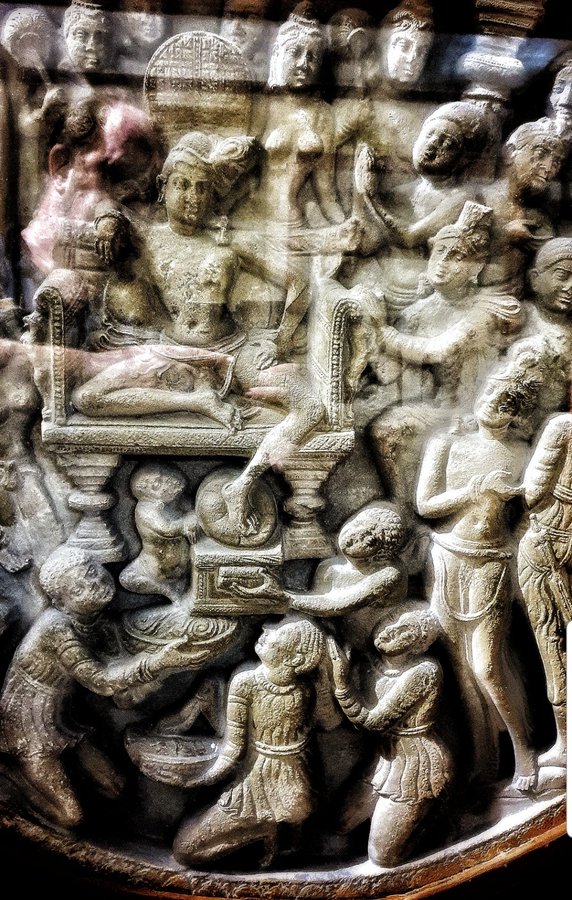
Buddha preaching in Tuṣita, Amaravati, Satavahana period, 2d century AD.Indian Museum, Calcutta

Chanting the Names of Mañjuśrī
is a revelation given to the Master of Mysteries (Guhyendra) Vajrapāṇi, the vajradhara, directly into his “stream of consciousness” by the Lord (nātha)[10], no different from Mañjuśrī[11], the knowledge being (jñānasattva), the “gnosis embodiment”. Seven maṇḍalas (spheres, heavens, on the throne in the middle of which is seated the main deity) are revealed.

The Lord in the center of the maṇḍala can also be understood as the central element-the Maṇḍa-while the surrounding gods and goddesses are the containing element the La; and these are nontwo.”

The seven maṇḍalas and their central deities are respectively:
1. The Net of Illusion, Mañjugoṣa
2. The Great Maṇḍala of Vajradhātu, MahāVairocana
3. The Pure Dharmadhātu Wisdom (Womb), Arapacana
4. Mirrorlike Wisdom: Trailokyavijaya (Victorious over the Three Worlds), Vajra hūṃkāra, Vajrabhairava
5. Discriminative Wisdom: Vādisiṃha
6. Sameness wisdom: Vādirāj, Vāgīśvara (Lord of Speech)
7. Procedure-of-duty Wisdom: Mañjuvajra, Vajrasattva, Jñānakāya
Six Buddha Families, six Buddhas, six Mañjuśrī aspects, the Lord of Speech (Vāgīśvara) being the seventh. And also six cycles of Praise (anuśaṃsā).

1. Cycle of eleven Praises of Mañjuśrī, the 'knowledge being' (jñāna-sattva) , “who is the knowledge body of the Bhagavat, the knowledge body of all the Tathāgatas”.

2. Cycle of fifty-two Praises of the “pure and immaculate omniscient knowledge (sarvajñājñāna) and the secret Body, Speech, and Mind. “It is the speedy success of the Bodhisattvas who engage in the practice by way of Mantra.”

3. Cycle of fifty-two Praises of the undoing of all negativity and the appearing of good qualities. “It is the utmost cleansing of all who are utmost cleansed; and the utmost purity of those who are utmost pure.” “preserving the names and clarifying the meaning of the underlying nature of non two, is the inexpressibility of all dharmas.”

4. Cycle of nineteen Praises of practicing Mantras and chanting the non two and absolute names of the jñānakāya of Bhagavat Mañjuśrī the 'knowledge being, which is the jñānakāya of all the Tathāgatas”. And Mañjuśrī the 'knowledge being' will be revealed to those who Praise.

5. Cycle of fifty-one Praises to generate the best materialization of the formal body (rūpakāya), and “never will he descend to the certainty of the Śrāvakas, Arhats, and Pratyekabuddhas."

6. Cycle of immeasurable Praises leading to quickly accomplishing the Buddha merits, and becoming manifestly awakened to the incomparable rightly perfected enlightenment, as a King of the Dharma.
In this Revelation, the Buddha pronounces a first gātha consisting of the twelve vowels (in Sanskrit),
A Ā I Ī U Ū E AI O AU AṂ AḤ
followed by:
Stationed in the heart of the Buddhas abiding in the three times, am I (aham) the Buddha, gnosis embodiment." 
Wayman adds as a note:
The twelve vowels: Smrti (37-2 and -3), defends the theory of the ācārya Līlavajra that the twelve stand for the twelve bhūmis, ten of the Bodhisattva and two more that are Buddha and Complete Buddha stages.”

Smrti (37-2-8 to 37-3-1), gives a number of synonyms of the twelfth stage, all having a word "light" (prabha) as last member of compound.”
Light, prabha, Nous. At the matrix level (Dharmadhātu Womb, dharmayonir[12]), special codes and names are needed, ordinary language won’t work.

In the Gnostic tradition, the Great Invisible Spirit is the primordial Light (Father)[13]. It is from his womb, his silence, his "matrix", that a triad of powers emerges: the Father, the Mother and the Son. The Son is a triple person in himself. The primordial triad is presented as a monad or pentad, called the "five seals". The manifestation of the (primordial) Father takes place in a glorious place (Ennead), the throne room, where the secret name (the (five) vowels) of the Father is inscribed. The entities above the Ogdoade (eight level) address hymns to him.
"(Son:) How do they sing?
(Hermes:) You have reached the point where we will no longer be able to speak to you.[14]"
The Ogdoad and the Ennead, from Ecrits gnostiques Pléiade, p. 964
"(Son:) I am silent, O my Father. I wish to sing you a hymn in silence.
(Hermes:) Sing it to me then, for I am the Intellect.
(Son:) The Intellect is intelligible to me. Hermes, he who cannot be interpreted, For he withdraws into himself.
.../... I invoke from the bottom of my heart your mysterious Name:
a ō eeō ēēē ōōō iii ōōōō ooooo ōōō ōō uuuuuu ōō ōōōō ōōōō ōōōōō ōōōō
"
A note explains that scribes often make intentional errors in transcribing the name of God, which must be transmitted by the initiator.
Note from Ecrits gnostiques Pléiade, p. 962 The name of God is often written a ee ēēē iii ooooo uuuuuu ōōōōō. This means that in the seven spheres or planets there reign twenty-eight particular gods, one more in the next than in the previous, all together constituting the one God."

There are lots of apparent similar structures and materials here, that ought to be further examined by specialists in both fields.
 
***

[1] Martyrdom of Isaiah, Testament of Hezekiah, and Vision of Isaiah.

[2] Ascension d’Isaie, Translated into French by Eugène Tisserant in 1909, Letouzé et Ané, éditeurs, Paris.

[3] L' « Ascension d'Isaïe » à travers la prédication d'un évêque cathare en Catalogne au quatorzième siècle, Mathias Delcor, 1974

[4] Ascension of Isaiah, M. A. Knibb, edited by James H. Charlesworth. Garden City, NY: Doubleday, 1985. (pp. 164-176) [This digital edition omits all of the notes in the original and reproduction.]

[5] This reflects the proto-Trinitarian or subordinationist perspective of the text.

[6] Compare with Brahma , the first god, who thinks he is the creator god.

[7] “And when she was betrothed, she was found to be pregnant, and Joseph the carpenter wished to divorce her. But the angel of the Spirit appeared in this world, and after this Joseph did not divorce Mary; but he did not reveal this matter to anyone. And he did not approach Mary, but kept her as a holy virgin, although she was pregnant. And he did not live with her for two months. And after two months of days, while Joseph was in his house, and Mary his wife, but both alone, it came about, when they were alone, that Mary then looked with her eyes and saw a small infant, and she was astounded. And after her astonishment had worn off, her womb was found as (it was) at first, before she had conceived. And when her husband, Joseph, said to her, "What has made you astounded?" his eyes were opened, and he saw the infant and praised the Lord, because the Lord had come in his lot. And a voice came to them, "Do not tell this vision to anyone." But the story about the infant was spread abroad in Bethlehem. Some said, "The virgin Mary has given birth before she has been married two months." But many said, "She did not give birth; the midwife did not go up (to her), and we did not hear (any) cries of pain." And they were all blinded concerning him; they all knew about him, but they did not know from where he was. And they took him and went to Nazareth in Galilee.”

[8] Chanting the Names of Manjushri, The Manjusri-Nama-Samgiti, Sanskrit and Tibetan Texts, Alex Wayman, Motilal 1985

[9] 'Phags pa 'jam dpal gyi mtshan yang dag par brjod pa.

[10] Śākyamuni, Bhagavat, Sambuddha.

[11] “O Bhagavat, you have self-originated the gnosis-body, the great uṣṇīṣa, the master of speech, the gnosis-embodiment of Mañjuśrī, the knowledge being.”

[12] “Smrti (46-3-3), by knowing the nature of all the dharmas. "Dharma-womb": Smrti (46-3-3), because devoid of personal-self or dharma-self, makes an end to phenomenal life. [Notice the three kinds of Tathāgatagarbha set forth above under VI, no. I, so "progenitor" is the Dharmadhātu womb; "son" is the Dharmakāya embryo; and "womb-source" as well as "dharma-womb" amount to the third kind, with two qualifications of dharma.]”

[13] "Livre sacré", Ecrits gnostiques, Pleiade, p. 514

[14] Blog Le Corps de Gnose, source du Corps mystique, 22/12/2021