Affichage des articles dont le libellé est Dzongsar Khyentse. Afficher tous les articles

mercredi 22 janvier 2025

Des lignées et des familles surmontant leurs "obstacles"

Sogyal Lakar, Yangsi Dilgo, Tsikey Chokling (capture d'écran vidéo Youtube)

Les conflits de génération sont encore plus pénibles chez les tulkus. Celui qui était votre disciple peut devenir votre régent, tuteur ou guru. Plus vous avez été brillant dans une précédente existence et plus on peut vous reprocher de ne pas l’être, voire pire, dans la suivante. Dans le “clan Khyentse”, la situation est encore plus complexe à cause des nombreuses relations familiales et dynastiques. On y est souvent tulku de père en fils et de grand-père à petit-fils, les lignées spirituelles croisant les lignées de sang.

Un détenteur est censé préserver la tradition et le système de reproduction de ses prédécesseurs et successeurs, en dépit des temps qui changent. Le statut même du tulku y joue très logiquement un rôle crucial. Les difficultés sont plus grandes pendant des périodes de grands chamboulements. Les grands écarts à faire deviennent alors insupportables. Tous les espoirs sont investis dans un jeune tulku. Tout est mis en oeuvre pour qu’il soit aussi brillant que le précédent. Les “offices de lama” (bla brang) ont été instaurés pour gérer le passage entre un grand maître précédent, un gérant, et le tulku, son (ré-)éducation, et surtout son patrimoine. Jusqu’à l’intronisation du tulku, en théorie…

Depuis l’invasion du Tibet, l’exil des maîtres tibétains, et leur venue en Occident, nous avons été témoins des difficultés des jeunes tulkus de nos maîtres. L’adolescence d’un tulku doit être particulièrement difficile. Jouer un vieux sage quand on est encore jeune… The show must go on. Les marques de respect et même de dévotion, quand on ne s’est pas encore prouvé, ne doivent pas être évidentes, tant qu’on ne les tient pas pour acquises. Mais l’office du lama (bla brang) veillera au grain. Les intérêts de l’office et du jeune individu tulku ne sont pas forcément les mêmes. Même les plus grands soulèvent parfois le voile sur leurs difficultés. Nous avons pu être témoins de désaccords sur le choix du tulku, et de clashes entre des offices de lama et leurs tulkus. Souvent juste des bribes, car le silence est d’or. Des tulkus qui se rebiffent et qui partent, en renonçant à leur statut de tulku, ou tout en le gardant. Certains reviennent. Des tulkus qui se rebellent, et qui sassagissent plus tard. Ou pas, certains s’essaient à la folle sagesse, inspirés par l’exemple de lamas généralement admirés pour avoir su si bien comprendre ce que veulent les occidentaux, et/ou en les mettant au pas. Admirés par leurs grand-pères, oncles, gourous et grand-gourous.

Certains tulkus vieillissants ont bien compris qu’il est quasiment impossible de se comporter en vieux sage, ou de faire semblant d’être des saints, en dépit de leurs propres dispositions et inclinaisons. Ils ont trouvé qu’il est plus facile de faire semblant d’être des mahāsiddhas, de déployer de la folle sagesse, et d’aider les disciples à briser les concepts et leur égo, en ne se comportant justement pas selon leurs attentes. Quelle est la part de l’homme, quelle est la part du tulku ? Qui se pose cette question ? Un tulku scrupuleux ? Un disciple déçu ? La plupart ne fait pas de distinction entre l’artiste et son oeuvre, laquelle est au fond sa propre personne, quand on est tulku.

Quand on est un jeune tulku qui a grandi dans un monde globalisé, vivant quasiment en VIP, qui connaît l’envers du décor et son cynisme, on peut prendre conscience de la vanité de certains aspects de la tradition, souvent les plus spectaculaires, mais qui rapportent le plus au monastère et à l’office. Des doubles contraintes et des choix difficiles partout. Presque comme ceux d’un être ordinaire. Où se trouve l’authenticité ? Dans la tradition ? Dans l’imitation d’un mahāsiddha légendaire et/ou fictif ? Dans l’imitation d’un imitateur de mahāsiddha ? Généralement considéré comme une réussite selon les critères des huit dharmas du monde.

Les tulkus se cherchent de différentes façons (sage, pas sage), mais il est rare qu’ils renoncent définitivement à leur identité de tulku. C’est ce qu’ils semblent tous avoir en commun. Même un Krishnamurti, reconnu comme une sorte de messie, renonce à son statut, à “la tradition”, mais continue de travailler comme une sorte de messie, tout en refusant ce rôle. Il est si difficile, voire impossible, de renoncer à une certaine idée de soi.

Après avoir consacré un premier blog (2021) à Yangsi Dilgo exprimant son admiration pour Chogyam Trungpa, j’en avais fait un autre suite à une vidéo postée par un lanceur dalerte, avec des allégations d’abus. Je n’ai pas connaissance de déclarations, témoignages etc. justifiant ces allégations, donc je n’en parlerai pas ici. J’aborderai en revanche des sujets relevant de ce que j’ai exposé ci-dessus. La lettre[1] de démission publiée par Shechen le 8 janvier 2025 ne mentionne que les déclarations de Yangsi Dilgo ne se considérant un “Lama de Shechen”, sans autre explication concrète ("in light of numerous concerning incidents").

D’autres vidéos de Yangsi Dilgo surfacent, notamment une, il critique lattitude de lamas tibétains mercantiles en Asie (Ka-Nying Ling Dharma Society, Malaysia le 3 août 2023), et une autre il adresse des louanges et des prières à Sogyal Lakar[2] à l’occasion de la consécration du stūpa de commémoration qui lui est dédié, le jour du cinquième anniversaire de parinirvana de Sogyal le 28/08/2024. Dilgo Yangsi semble admirer les succès en Occident de Chogyam Trungpa et de Sogyal Lakar, et leur transgression des attentes (“folle sagesse”), car ils auraient “percé leur esprit dualiste” (“break through my dualistic mind”). Il voudrait en faire autant comme il paraît dans la vidéo du lanceur dalerte, où il semble vouloir ritualiser la transgression. Aucune mention de leurs abus en revanche. Leur “réalisation” (“parinirvana”) ne fait aucun doute pour lui. Ils sont des objets dignes de louanges et de prières et des exemples à suivre.

Yangsi Dilgo fait allusion au mercantilisme de lamas tibétains voyageant en Asie pour faire toutes sortes de rituels (Jambhala, dieu des richesses) en échange d’offrandes, et indirectement à une pratique de bouddhisme mondain[3]. Être bouddhiste signifie représenter les Trois Joyaux : le Bouddha, le Dharma et la Sangha. Cela implique de s'engager sur la voie de la transformation personnelle, en cultivant la gentillesse, la compassion et la sagesse. Il souligne que le bouddhisme n'est pas une simple question de rituels ou d'offrandes, mais une transformation profonde de l'esprit qui nécessite un engagement sincère et une pratique continue.

Il y a les discours et il y a les actes, comme pour nous tous. Sauf que pour les “tulkus”, les gurus réincarnés reconnus comme tels, la dissonance entre leurs discours et leurs actes est idéologiquement due à notre perception impure, à la résistance de notre saisie égotique. Celui qui s’engage dans le guruyoga[4] ne peut plus voir des fautes en lui. Tel qu’un guru traite ses gurus, tel il souhaite être traité par ses propres disciples. Tel qu’un tulku souhaite être traité en tulku, tel il traitera les autres tulkus. Souscrire au parinirvana de Sogyal Lakar est préparer la confirmation de son propre parinirvana au moment venu. Les disciples de Sogyal viendront à sa cérémonie. Le culte des tulkus s’entretient dans les lignées. Il est même crucial pour leur survie.

Quelle que soit la réalité (naturelle), idéologiquement et à force de le répéter, Sogyal Lakar est un grand lama qui est passé au parinirvana le 28 août 2019. Les tulkus confirmant cela verront le moment venu leur propre parnirvana confirmé, garantissant ainsi la continuation de leur culte sous forme de tournées de reliques (sku gdungs), statues en cire, de stūpas, de cérémonies de commémoration, etc. Yangsi Dilgo Khyentsé y pense, Dzongsar Khyentsé y pense, toute la famille des Khyentsé y pense. Il en va de leur survie en tant que “famille”. En dépit de quelques couacs malheureux.

Le jour du cinquième anniversaire du “parinirvana” de Sogyal Lakar, avec la consécration de son stūpa de commémoration, semble être une étape importante dans le processus de réhabilitation et de sanctification de Sogyal Lakar. La “famille” Khyentsé resserre les rangs. Shechen Rabjam est venu enseigner à Lerab Ling en novembre 2024[5]. Dzongsar Khyentsé a visité Rigpa Paris le 8 décembre 2024, confirmant le parinirvana de Sogyal Lakar et sa prise en charge de la formation continue des enseignants sénior de Rigpa. Il fait leur louange pour avoir résisté à tous les “obstacles”, et le maintien de leur engagement. Il confirme également la loyauté de la “famille” Khyentsé. Le culte de Sogyal Lakar peut continuer. Les “obstacles” ont été dissipés. La réhabilitation est une art que l’on maîtrise bien dans le bouddhisme tibétain, où la loyauté n’est pas un vain mot.

***

[1] 8th January 2025
TO WHOM IT MAY CONCERN

In consideration of Khyentse Yangsi's repeated statements that he does not regard himself as a "Shechen Lama," and in light of numerous concerning incidents, we sadly confirm that Khyentse Yangsi. Ugyen Tenzin Jigme Lhundrup, is no longer affiliated with Shechen Monastery—founded by Kyabje Dilgo Khyentse Rinpoche—and is relieved of all associated duties and responsibilities until further notice.

Shechen Monastery Management Committee
[2] “(1:55) I have not seen lamas, Tibetan lamas, Bhutanese lamas, or any kind of lamas, khenpos or rinpoches, [open their centers to other lamas]. It's not something that people usually do, because, you know, when it becomes your own personal center, your own personal home, your own personal sponsors, your personal contacts, your personal disciples, you don't want them to be taken away and follow other teachers, and other masters. You would definitely want them to only follow you, and be loyal to you. But Sogyal Rinpoche really opened everything and shared everything with all other teachers. I think that is a big thing to do, it was remarkable. It's not easy to do, but a remarkable thing to do. I rejoice in Rinpoche’s Dharma activity. I rejoice in his disciples, all disciples, who without any personal agenda and ego, offered a real contribution, practicing the Dharma themselves, and contributing to Rinpoche’s activity. I also would like to say May Rinpoche’s reincarnation be swiftly reborn. May Rinpoche’s activity continue. May the precious momentum, that Rinpoche has left always continue in the hearts of all the people who are very dear and close to Rinpoche. I make all these aspirations and offer my rejoicement and thanks. Thank you so much. Thank you so much. Thank you so much.” Message for Sogyal rinpoche memorial stupa consecration (End of August 2024)

[3] Il critique la tendance, en particulier dans la culture asiatique, à se contenter de rituels et d'offrandes sans s'engager dans une véritable pratique du dharma. Il souligne que les lamas tibétains ont une part de responsabilité dans cette situation, en promouvant des pratiques axées sur la richesse matérielle plutôt que sur la transformation intérieure. Il met en garde contre l'utilisation du dharma pour satisfaire des désirs mondains et souligne que le véritable but de la pratique est de développer la sagesse, le détachement et la dévotion. Il insiste sur l'importance de la pratique de l'esprit dans le Vajrayana, affirmant que les rituels et les visualisations sont inutiles sans une base solide dans la méditation et la compréhension de la nature de l'esprit.

[4] Kongtrul Lodrö Thayé (1813 - 1899) utilisé dans les lignées Kagyu, ou Le chemin de la grande perfection, composé par Patrul Rinpoché (1808–1887), utilisé dans la lignée Nyingma. Dans le chapitre Guruyoga du Flambeau de la certitude, on peut lire :
Toutes les actions de ce précieux et parfait Lama,
Quelles qu’elles soient, sont bonnes.
Tout ce qu’il fait est excellent.
Entre ses mains le travail, maléfique d’un boucher
Est bon, et apporte des bienfaits aux bêtes,
Inspiré par la compassion pour toutes.
Quand il s’unit sexuellement de façon impropre,
Ses qualités s’accroissent, et s’élèvent comme renouvelées,
Montrant que les moyens et la sagesse ont été réunis.
Ses mensonges qui nous dupent,
Ne sont que les signes habiles par lesquels il nous
Guide sur le chemin de la liberté.
Lorsqu’il vole, les biens volés se changent en denrées nécessaires pour soulager la pauvreté de tous.
Quand un tel Lama réprimande
Ses paroles sont de puissants mantras
Pour faire disparaître la détresse et les obstacles.
Ses coups sont des bénédictions
Qui accordent les deux siddhis et réjouissent tous les hommes fervents et respectueux.
Ainsi qu’il est dit ci-dessus, apprécions les aspects bienfaisants de toutes ses actions
.”
[5]Lerab Ling, 6-10 November 2024. Only the teachings and empowerments are listed below. The complete list of lungs/reading transmissions can be found in this file.
6 November:
Teaching on shamatha based on Dilgo Khyentse Rinpoche's text, The Sage Who Dispels Mind’s Anguish, including its reading transmission
Empowerment of Medium-length & Brief Blessing of Tendrel Nyesel
7 November:
Teaching on lojong using Jamyang Khyentse Wangpo's Ambrosia for the Mind
Empowerment of Nyingtik Saldrön
8 November: Empowerment of Vajra Heart, A Spontaneous Song that Reveals the Ultimate
8 & 9 November:
Teaching on kyerim using Shechen Gyaltsab Gyurme Pema Namgyal's text: A Clear, Concise and Simple Explanation of the Generation and Completion Stages for the Benefit of Beginners (Beginner’s Guide to Kyerim)
9 November: Empowerment of Netik Phurba
9-10 November: Root empowerment of Chimé Pakmé Nyingtik
10 November: Teaching on semtri using Dilgo Khyentse Rinpoche's Oral Instructions

Source : Rigpawiki

vendredi 17 janvier 2025

Loyautés renouvelées entre Rigpa et Dzongsar Khyentsé


Sogyal Lakar (1947-2019)[1] avait démissionné de son rôle de directeur spirituel de l'organisation Rigpa en août 2017, suite à de graves accusations d'abus envers certains de ses étudiants, et la mention par le Dalai-lama de cette situation le 1er août 2017. Après la démission de Sogyal Lakar, Rigpa avait nommé un “Conseil de vision” (Vision Board), composé d'éminents lamas bouddhistes tibétains, dont Dzongsar Khyentsé (DJK) et Mindrolling Jetsün Khandro Rinpoché. Ce conseil avait pour mission de clarifier la vision de Rigpa, de veiller à la qualité des enseignements et de garantir un environnement sûr et bienveillant pour les étudiants. Des lamas Nyingmapa comme Khenpo Namdrol, Orgyen Tobgyal et DJK avaient recommandé aux disciples de Sogyal Lakar de purifier et restaurer leur engagement samaya auprès de lui.

En mars 2019, Mindrolling Jetsün Khandro Rinpoché avait accepté d'assumer la fonction de directrice spirituelle de la congrégation de Rigpa Lerab Ling. Ainsi Lerab Ling pouvait être restitué comme membre de lUnion Bouddhiste de France. Le 9 juillet 2022, lors d’une petite cérémonie en présence de Jetsün Khandro Rinpoché, et de Khenchen Namdrol Rinpoché, quelques disciples de la première heure de Sogyal Lakar furent nomméssenior teachers, en renouvelant leur allégeance devant la photo de leur maître décédé Sogyal Lakar.

Le 8 décembre 2024, DJK fait une visite éclair (“An afternoon with DJK in Paris”, part 1, part 2) au centre Rigpa de Paris, où il rencontre les disciples de Sogyal Lakar. Une liste de questions[2] est soumise auxquelles DJK donna des réponses. Il y aurait d’autres choses à dire au sujet de ces deux vidéos, notamment sur le statut du tulku, mais je me limiterai ici à certaines questions particulières concernant la gestion de la "Seigneurie" de Sogyal.
Question : “Après le parinirvana de Sogyal Rinpoché, il y a 5 ans, nous avons été conseillés de ne pas chercher d'autres maîtres, mais de commencer à transmettre les enseignements nous-mêmes. Comment le faire de manière raisonnable avec une formation limitée ?” (part 2, 59:20)
Traditionnellement dans le bouddhisme tibétain, il est courant pour les disciples de chercher d'autres maîtres après le décès de leur enseignant principal, plutôt que de commencer immédiatement à enseigner eux-mêmes. Mais les étudiants de Rigpa avaient donc été conseillés de ne pas chercher d'autres maîtres, et de commencer à transmettre les enseignements eux-mêmes. Sans doute pour préserver l’héritage de Sogyal Lakar. Conseillés par qui ? Peut-être par Sogyal avant sa mort, par DJK et Khandro Rinpoché, par le Vision Board ? Ou par les maîtres tibétains qui avaient visité Lerab Ling et Rigpa Paris depuis 2017[3] ? Ce conseil explique par ailleurs la cérémonie de consécration de senior teachers qui eut lieu en 2022. Les enseignants “séniors” pouvaient ainsi transmettre l’héritage de Sogyal Lakar aux nouveaux venus, qui n’avaient pas personnellement connu Sogyal Lakar.

Lors des échanges à Paris en décembre 2024, DJK semble approuver cela. Il mentionne les défis (“obstacles”) auxquels Rigpa a été confrontée après le parinirvana de Sogyal Rinpoché. Il fait l'éloge de la résilience de Rigpa, la qualifiant d'« accomplissement extraordinaire » et de « signe encourageant pour le Bouddha Dharma ». Il encourage les étudiants de Sogyal Rinpoché à continuer à partager le Dharma malgré les difficultés.
DJK : “J’ai observé Rigpa. J'ai toujours dit que Rigpa était vraiment important le pour le Dharma en général et particulièrement pour le Dharma de lignées tibétaines. Non seulement Sogyal Rinpoché est passé au parinirvana, mais devait faire face à des défis énormes, extérieurs, intérieurs et secrets. Et cela continue toujours. C’est un accomplissement extraordinaire. Je dirais bien sûr que c’est la bénédiction des gourous, des dharmapalas, et la dévotion des étudiants. Le Dharma a toujours eu beaucoup d’obstacles. Certains obstacles sont vraiment énormes. Regardez ce qui s’était passé avec les universités de Nālandā et Taxila. Elles ont disparu. Regardez Peshawar, en Afghanistan (Oḍḍiyāna), le berceau des tantras, plus aucune trace.”
Nālandā, Peshawar, Sogyal et Rigpa, même niveau..., mêmes “obstacles”. DJK mentionne ses discussions avec des étudiants séniors et leur hésitation de transmettre et d’enseigner. Ils ont besoin d’une structure pour les soutenir. Ce sera le programme Milinda de la Fondation Khyentsé, donné par une équipe denseignants.

Question suivante :
Dans Le livre tibétain de la vie et de la mort, Sogyal Rinpoché a dit que dans le Dzogchen la vue est présentée directement à l'étudiant par le maître, qui doit avoir une réalisation complète et incarner cette réalisation, afin que le l'étudiant puisse recevoir cette présentation. L'étudiant doit avoir aussi atteint le point où il possède à la fois l'ouverture d'esprit et la dévotion, qui va lui permettre d'être réceptif au vrai sens du Dzogchen. Que se passe-t-il pour les étudiants qui ont rejoint Rigpa après le décès de Sogyal Rinpoché ou qui ne l'ont pas rencontré ? Quelle place doit prendre la dévotion, et comment concilier cela avec le d'autres grands maîtres qui viennent à Rigpa comme vous-même, pour présenter la nature de l’esprit et enseigner le Dzogchen ? Le souci c’est que ces étudiants pourraient alors décider de suivre ces maîtres et de rejoindre leur saṅgha respectif, et quitter Rigpa progressivement. Est-ce que vous avez des recommandations ou des clarifications à faire ?

DJK : “Un pratiquant du vajrayāna n’est pas un pratiquant śrāvaka. Il faut prendre le voeu de bodhisattva. En ce qui concerne les instructions de présentation (ngo sprod), de Dzogchen, je m’en suis déjà expliqué au début de cette séance. Certaines peuvent l’avoir directement. C’est tout à fait personnel. Un pratiquant de Dzogchen doit pratiquer la bodhicitta, c’est-à-dire être concerné par l’éveil d’autrui. Il lui faut faire tout ce qui est en son pouvoir. Cela pourrait être simplement de faire des photocopies, ou de nettoyer une pièce. Je vois un centre bouddhiste comme Rigpa, ou un monastère, vraiment comme un “véhicule” pour un bodhisattva débutant. C’est un véhicule facile à utiliser à cet effet. Cela implique évidemment des émotions humaines. Par exemple, moi-même, (Sogyal) Rinpoche, Khyentsé Chökyi Lodrö, à chaque fois que je viens ici, ou à chaque fois qu’il y a un Européen qui veut aller quelque part dans un centre, je leur dis “Va à Rigpa !” (rires). Même si je ne suis pas un membre du Saṅgha, ou du Vision Board, etc. Donc j’utilise ce “véhicule”, voilà ce que je veux dire. Notamment des gens qui sont un peu enclins à …. (rires) … je ne sais pas… un peu sauvage, avec un certain caractère … Va à Rigpa ! (rires). Je vous donne un exemple. Des gens qui croient en la méditation assise, le végétarisme, pas d’alcool, pas de “guru business”, ceux-là, je ne les envoie pas ici (rires). Mais de toute façon, ceux-là ne viennent pas me voir. (rires) Ce que je veux dire c’est qu’il faudrait vraiment utiliser (Rigpa) comme un “véhicule”, vraiment. (Rigpa) est très bien établi. Et qui a traversé de très gros tests, de nombreuses fois.”
La séance se termine avec une question sur la nouvelle collaboration entre Siddhartha's Intent et Rigpa.
C'est la première fois que Siddhartha's Intent et Rigpa, les deux sanghas, organisent ensemble votre visite à Paris. La collaboration entre les deux sanghas se retrouve aussi sur le projet de Milinda, qui est pour entraîner les enseignants du futur. Est-ce que vous pouvez partager votre vision de comment nous pourrions rendre cette collaboration encore plus forte dans le futur ?
DJK commence par rassurer l'auditoire en disant qu'il n'y a pas lieu de s'inquiéter, car la façon dont les Tibétains fonctionnent est déjà très efficace pour ce genre de collaboration. Il compare cela à une "famille mafieuse italienne", soulignant l'importance de la fidélité et de la gratitude au sein de la lignée. Le “clan Khyentse” (K-clan) pourrait-on dire... Il illustre ce point en évoquant l’énorme gratitude pour la contribution extraordinaire de Lerab Lingpa (1856-1926) en écrivant le commentaire du lCe btsun snying thig, qui est "tellement beau" que DJK l'avait lu 40 fois. C’est ce genre de loyauté de clan Yakuza que DJK dit ressentir envers Lerab Lingpa et sa “famille”. Probablement la même loyauté que ressent Shechen Rabjam Rinpoché, un autre membre de la "famille".

Dernière question :
Comme vous êtes la réincarnation de Jamyang Khyentsé Chökyi Lodrö, le maître racine de Sogyal Rinpoché, vous jouez vraiment un rôle crucial dans notre lignée, et en particulier pour le saṅgha de Rigpa. Est-il donc possible que vous veniez plus souvent pour enseigner et transmettre votre esprit de sagesse à nous tous ?"

Je crois que j’ai déjà répondu à cela, n’est-ce pas ?
L’enjeu de la rencontre entre Rigpa et Dzongsar Khyentsé est le sort de la "Seigneurie[4]” de Sogyal et de ses “âmes”. Pour préserver l’héritage de Sogyal Lakar, Rigpa, il avait été conseillé “de ne pas chercher d'autres maîtres”. L’héritage spirituel étant assez maigre, les enseignants séniors ne se sentaient pas toujours à la hauteur. La loyauté au clan des anciens était plus ou moins acquise, mais les nouveaux candidats arrivant à Lerab Ling et à Rigpa n’avaient pas ce lien privilégié (“présentation” Dzogchen) avec le maître. Les maîtres tibétains de visite à Lerab Ling ou à Rigpa pourraient facilement les débaucher, et ainsi appauvrir le “véhicule”. Que faire pour arrêter ou éviter la saignée ? Jamyang Khyentsé Chökyi Lodrö était le maître de Sogyal Lakar, et Dzongsar Khyentsé étant une réincarnation du maître du maître, il était logique de faire appel à ce dernier, puisqu’il est de la même famille “mafieuse” ou “yakuza”.

Sogyal Lakar and Dzongsar KR in the UK, September 2016
(gratte-dos ajouté par mes soins)

La majorité des questions se rapportait au resserrement des liens du clan et au sort des “âmes” en dérive. DJK rassure Rigpa, il ne prendra pas de “serfs” à Rigpa, il leur envoie même de nouveaux candidats “un peu sauvages”. “va à Rigpa !” Les nouveaux candidats, fraîchement équipés de voeux de bodhisattva, pourront être mis à la tâche (“karma yoga”) dans leur nouveau “véhicule”. Les enseignants séniors de Sogyal Lakar feront de la formation continue Milinda, pour étoffer leur savoir et échafauder leur confiance, et pourront ainsi transmettre un héritage de Sogyal plus consistant que l’original. Les “serfs” qui n’ont pas reçu de “présentation Dzogchen” de Sogyal Lakar, pourraient la recevoir d’autres lamas. Avec Dzongsar Khyentsé , cela restera de toute façon dans la même famille. Une famille où l’on n’oublie jamais où se situent ses loyautés. Évidemment que Dzongsar Khyentsé viendra les voir plus souvent pour enseigner et transmettre son esprit de sagesse. Ce qui est arrivé à Nālandā et à Peshawar ne doit pas arriver à Rigpa.


[1] Lire le livre Sex and Violence in Tibetan Buddhism - The Rise and Fall of Sogyal Rinpoche, de Mary Finnigan et Rob Hogendoorn. Voir mon blog Sexe et violence dans le bouddhisme tibétain.

[2] •Le Vajrayana est-il fait sur mesure pour les gens de l'époque moderne, malgré le temps requis pour la pratique formelle ? Pourquoi ne pas rendre les enseignements du Zen ou du Mahamudra plus accessibles ?
•Quelle est la différence entre Samaya et engagement de pratique dans le Vajrayana ?
•Comment vous assurez-vous que les samayas entre vous et vos étudiants restent purs, étant donné le grand nombre de disciples et leurs attentes ?
•Comment comprendre les citations apparemment contradictoires qui disent qu'un yogi ne devrait jamais passer de temps avec un briseur de samaya, tout en étant heureux en toute compagnie ?
•Quelles sont les principales différences entre donner des enseignements et des transmissions de pouvoir en Occident et en Asie, et entre les donner à des pratiquants laïcs ou à des moines ?
•Comment surmonter le manque de confiance en soi que de nombreux maîtres attribuent aux Occidentaux ?
•Pourquoi y a-t-il tant de problèmes et de controverses autour du système des tulkous ces derniers temps ? Quel est le problème ?
•Le système des tulkous, apparemment initié au Tibet avec les Karmapas pour préserver les lignées et maintenir une influence politique, a-t-il toujours eu cette dimension de pouvoir ?
•Après le parinirvana de Sogyal Rinpoché, il y a 5 ans, nous avons été conseillés de ne pas chercher d'autres maîtres, mais de commencer à transmettre les enseignements nous-mêmes. Comment le faire de manière raisonnable avec une formation limitée ?
•Concernant les instructions directes du Dzogchen, quelle place doit prendre la dévotion pour les étudiants qui ont rejoint Rigpa après le décès de Sogyal Rinpoché ou qui ne l'ont pas rencontré ? Comment concilier cela avec le suivi d'autres maîtres ?
•Comment renforcer la collaboration entre Siddhartha's Intent et les centres Rigpa, notamment dans le cadre du projet Milinda pour former les enseignants du futur ?
•Est-il possible que vous veniez plus souvent pour enseigner et transmettre votre sagesse, étant donné votre rôle crucial en tant que réincarnation de Jamyang Khyentsé Wangpo ?

[3] Entre autres Dzongsar Khyentse Rinpoché, et Mindrolling Jetsün Khandro Rinpoché, conseillers spirituels de Rigpa. Khenchen Namdrol Rinpoché, Dzogchen Ponlop Rinpoché, Sa Sainteté le 42e Sakya Trizin Ratna Vajra Rinpoché, Son Éminence le 7e Kyabje Yongzin Ling Rinpoché ?

[4] Le statut des serfs est caractérisé par : une liberté restreinte, l'impossibilité de quitter la seigneurie sans autorisation, l'obligation de travailler pour le seigneur, des limitations sur le mariage et l'héritage

samedi 19 mars 2022

Back to Basics (and forget about the mess)

"Handful of leaves"

When thanks to a long preparation starting from the Counter-Enlightenment, the search for the cradle of the primitive religion of Humanity in Aryen regions, Theosophy, Anthroposophy, Transcendentalism, etc., it was generally assumed in spiritual (and later New Age) circles, that the “mahatmas” (great souls, great teachers) of the primitive religion of Humanity were still living and teaching in Tibet, the diaspora of Tibetan teachers after the Chinese invasion of Tibet was welcomed as a sort of blessing for Western spirituality. Finally, Western spiritual searchers were able to (re)connect with religion in one of its purest forms, after having been preserved for centuries in the Himalayas. The highest, most subtle and esoteric teachings were of course those belonging to the diamond vehicle, vajrayāna, offering the possibility to become a Buddha in one lifetime, under the guidance of an authentic lama.

At the same time, the Western public was reassured that “Buddhism” was hardly a religion. The Buddha was a rationalist, who didn’t believe in magic, who was only interested in the Real, and in thusness. Anything that looked religious was in fact a skillful means (upāya), meant to guide individuals according to their specific needs. Anything mythological, religious, magic, etc. had its sting removed, through reinterpreting it symbolically, psychologically, “spiritually”, philosophically, etc., making it more palatable to a secular Western audience. An educated newly converted Western would surely not run the risk of getting involved in a full blown religion, or even a cult. On top of that Tibet’s Dalaï-lama received the Nobel Prize for Peace in 1989. And regardless of his more traditional activities, his words have always been full of modern secular wisdom.

A Dalai-Lama meme

After a short honeymoon period, things started to go awry and in the aftermath of the scandals of summer 2017 around Sogyal Lakar and Rigpa, a definite divorce started to set in. After 2017, one of the defense strategies of Dzongsar Jamyang Khyentse R. (DJKR) was that Sogyal hadn’t prepared his students properly to receive Vajrayāna and Dzogchen teachings. Regardless of anything that had happened, the inadequate preparation and crash course in Vajrayāna, bypassing crucial training stages, was pointed out as being responsible for all the problems. Through their great compassion Tibetan masters had given in to the unreasonable demands of unprepared and immature Western students to receive the highest teachings and enter a master-student relationship ("guru devotion"), “the quintessence of vipashyana” as DJKR writes in Poison is Medicine.

Now things start to look bad for gurus, “guru devotion” and vajrayāna, DJKR decides to go back to the old Secret Vajrayāna strategy. Vajrayāna was never meant to be given so easily to beginners. Students should not engage with a “guru” and vajrayāna before they are totally ready to enter a “guru devotion” pact, and all this needs to take place very discreetly. That’s why Vajrayāna was called “Secret Vajrayāna”.

In his discussion with neuroscientist Dr. Richard Davidson, DJKR convenes that “in order to disseminate dharma” (Richardson) in the West, a more compatible secular outlook would be better. Adding faith and devotion to mere “Mindfulness” would be beneficial. But faith and devotion “don’t just fly in the air”, they need to be anchored in a solid “view”, a doctrine (DJKR). Ultimately the “view” can only be properly conveyed and realized through the assistance of a guru. But first things first. Western students should not be scared away by talking about “guru devotion” and some of its unfortunate mishaps due to improper preparation. So yes, after all, neuroscientists and the Dalaï-lama could very well be right in wanting to “convey” the view in a way that is quote ‘secular’ in a way that could be appealing to everyone, to be more universal” (Richardson 15:27).

So it seems like back to basics for Buddhist centers, in order to win back the minds and hearts of Western converts. “Don’t mention Vajrayāna” is the motto, and start with common truths, mindfulness, sitting, breathing, and gradually work your way up to vajrayāna through talking about bodhisattvas, saving sentient beings, and only when the converts are ripe for their future career as a Buddha, whilst entering Vajrayāna to obtain the necessary tenure.
Now that the Vajrayana is being discussed publicly and in such detail, visitors to your Dharma centre may start asking questions about it.

If possible, try to avoid talking about the Vajrayana altogether. Focus instead on the beautiful and completely risk-free Theravadin teachings, which are a far better starting point than shunyata. Talk about impermanence and how life never brings us ultimate satisfaction.

Concentrate on wholesome, convincing, down-to-earth teachings. If you are asked about the Mahayana, highlight the bodhisattva’s tremendous motivation to enlighten all sentient beings. Point out that as we all have buddha nature, the enlightenment of all sentient beings is a real possibility, not just wishful thinking.

You can share simple techniques like being mindful of your breath or the sensations in your body because it belongs to the empirical world that appreciates the obvious, measurable benefits mindfulness can bring. But the statement ‘pray to the guru’ should never pass the lips of a Vajrayana practitioner. Why? Because everything to do with using desire as a path must be kept secret.

Many Tibetans wouldn’t think twice about telling someone to pray to the guru. In a way, it sounds quite harmless, but praying to the guru is actually an exclusive tantric practice that should be kept just as secret as paintings of deities in union. If you pray to your guru, you are praying to a living, breathing human being, which could so easily be misunderstood – especially these days.

If you are unable to avoid mentioning the Vajrayana, emphasize the Vajrayana view that everything is pure. At all costs, avoid mentioning the more advanced techniques of guru devotion, pure perception and unquestioning obedience to the guru.

Instead, explain that, according to the Vajrayana, we are all already buddhas – including our noisy, angry neighbours – but none of us have realised it yet. Later on, when the new person is ready to hear more, tell them that, according to the Mahayana, we become buddhas after a long and arduous journey.

The Vajrayana’s message is a little different because it tells us that the journey is the goal. It also tells us that we are already buddhas and all we need to do is realise our true nature and act accordingly.

It is not wise to extol the power and effectiveness of techniques like guru devotion until much later.

Start by teaching the technique of shamatha, then gradually introduce vipashyana. Once new students have got a handle on basic vipashyana, introduce the inseparability of appearance and emptiness, which is a higher level of vipashyana known as utpattikrama (kyerim) and sampannakrama (dzogrim). Only then can you start talking about the quintessence of vipashyana, which is guru devotion.

Try not to let scandals and criticisms discourage you. And don’t allow yourself to be persuaded that the Vajrayana is not for this time. The tantric texts tell us that the Vajrayana is tailor-made for this modern world. So rest assured that those who have a thirst for the truth, good analytical skills, a longing for objectivity, a need for empirical proof and a healthy mistrust of even the best reasons for trusting, are the perfect vessels for the Vajrayana teachings. If, that is, they are willing to give tantra a go
."

Extract from : Poison is Medicine - Clarifying the Vajrayana, Dzongsar Jamyang Khyentse
***

The Blessed One was once living at Kosambi in a wood of simsapa trees. He picked up a few leaves in his hand, and he asked the bhikkhus, ‘How do you conceive this, bhikkhus, which is more, the few leaves that I have picked up in my hand or those on the trees in the wood?

‘The leaves that the Blessed One has picked up in his hand are few, Lord; those in the wood are far more.’

‘So too, bhikkhus, the things that I have known by direct knowledge are more; the things that I have told you are only a few. Why have I not told them? Because they bring no benefit, no advancement in the Holy Life, and because they do not lead to dispassion, to fading, to ceasing, to stilling, to direct knowledge, to enlightenment, to Nibbana. That is why I have not told them. And what have I told you? This is suffering; this is the origin of suffering; this is the cessation of suffering; this is the way leading to the cessation of suffering. That is what I have told you. Why have I told it? Because it brings benefit, and advancement in the Holy Life, and because it leads to dispassion, to fading, to ceasing, to stilling, to direct knowledge, to enlightenment, to Nibbana. So bhikkhus, let your task be this: This is suffering; this is the origin of suffering; this is the cessation of suffering; this is the way leading to the cessation of suffering.’

[Samyutta Nikaya, LVI, 31]


dimanche 13 mars 2022

Meanwhile on the Science-Belief spectrum

"Davidson : [ ] one of the challenges in the modern dissemination of dharma in the West...

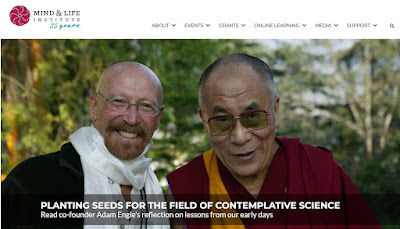
Another series of tweets by Dutch journalist Rob Hogendoorn pointed me to a Youtube discussion between Dzongsar Khyentse Rinpoche/Filmmaker Khyentse Norbu (DJKR) in Conversation with Neuroscientist Dr. Richard Davidson. As Rob Hogendoorn points out in one of his tweets "Dr. Davidson is a Professor of Psychology and Psychiatry at the University of Wisconsin-Madison and heads the Center for Healty Minds". Dr. Richard Davidson is a also a prominent member of The Mind and Life Institute and a good friend of Jon Kabat-Zinn, the inventor of Mindfulness (mindfulness-based stress reduction MBSR), who introduced Dr. Richardson to the Dalaï-lama.
It was at that meeting that my life and my work went through what Jon [kabat-Zinn] has called an orthogonal rotation. The Dalai-Lama was quite forceful and challenging and said that we've been using tools of modern neuroscience to study depression and anxiety and fear, why can't we use those same tools to study kindness and compassion. That was a wake-up call.” (Youtube)

Like good news journalism, positive psychology, self-improvement (Dale Carnegie) and attracting positive things into ones life, some neuroscientists seem to have made it their life’s quest to look into how our lives could be made more positive, which is possible thanks to brain plasticity or “neuroplasticity”. Neuroscientists study neurophenomenology, neuropsychology, neuroanthropology and behavioral neuroscience. Many modern practitioners of religions have high hopes in neuroscience, because, to them, neuroscience looks at the “link” between body and mind (“consciousness”) and could, who knows, prove the existence of “consciousness”, as being different from the body and capable to act independently from the body, even after physical death. Or it can perhaps one day teach us how manipulations on the physical “neuronal”, or “yogic”, level could influence consciousness, beyond its lifetime interaction with the body? A happy marriage between science and faith, why not?

"Your mission is to proceed up the Nung River in a Navy patrol boat"

To religious scientophiles Francesco Varela seems to be the neuroscientist who set the bar highest on the Science-Belief Spectrum (SBS), on the side of science (neurophenomenology). Jon Kabat-Zinn was the first scientist (Ph.D. in molecular biology) to successfully secularize an applied practice of “meditation”. Dr. Richard Davidson goes further down the “Nung river” of cultivating AND measuring compassion, well-being etc. Perhaps one day also emptiness and Bodhi?

Other religious scientophiles approach neurophenomenology from the other side and call their parapsychological effortsNoetic Sciences”. The Institute of Noetic Sciences (IONS) was co-founded in 1973 by former astronaut Edgar Mitchell.
The Institute conducts research on topics such as spontaneous remission, meditation, consciousness, alternative healing practices, consciousness-based healthcare, spirituality, human potential, psychic abilities, psychokinesis and survival of consciousness after bodily death.” (wikipedia)
Europe has its own Institut Suisse des Sciences Noétiques (ISSNOE), founded by Sylvie Dethiollaz, doctor in molecular biology, and supported by French celebrities as Frederic Lenoir, Igor et Grichka Bogdanov, etc. In 2017, Sylvie Dethiollaz could be seen in various TV-shows with her “research collaborator” in Out-of-body experiences, Nicolas Fraisse, who, from a young age onward had the ability to leave his body at will while his mind freely traveled around. The institute investigates resurrectional phenomena and is extremely interested in the Tibetan Buddhist Rainbow body.

Other Tibetan masters such as the Kagyu/Nyingma teacher Yongey Mingyur Rinpoche use the Steiner/Waldorf method for their educational projects with courses such as ‘Child Development from Birth to Rebirth’ (with "Dr Meyrav Mor, Dr Matthieu Ricard, Dr Richard Davidson and others") (see my blog Le réincarnationisme à l’école).

Influenced by and loyal to his father Thinley Norbu Rinpoché[1] (1931-2011) DJKR, defends a conservative traditional Tibetan Buddhism and at various occasions wrote openly against attempts to secularizeBuddhism[2] and integrate Western values such as democracy, rationalism, science. The present discussion with neuroscientist Richard Davidson is therefore surprising, but Dr. Davidson seems ready to go quite far on the belief spectrum to help DJKR to secularize “Buddhism” and the “Science of Meditation”. DJKR thinks that modernization” (“so called modern life”) “is basically a westernization (09:18)”, and that after first going through paganism, Christianity, Enlightenment, Western civilization is now stuck in rationalism [and science] (22:53 “Bodhi TV : An interview with Dzongsar Jamyang Khyentse Rinpoche[1]” 11/04/2021).

In the discussion with Dr. Davidson, there is an agreement about the recognition that “awareness” (tib. rig pa) is continuously with us (0:51), including during dreams. There is no separation in this “awareness”, there are no “bardos” (tib. bar do, intermediate state). There are various intermediate states, states or “momentary gaps” that are intermediate between two temporal limits.
“Davidson: The way I think you've explored in some of your films [ ] that's related to this is death and dying and “bardo”. The way we think of “bardo” as a scientist, it's kind of a gap, a momentary gap, when the normal constraints on our perception are suspended. It even could just be a brief moment, it could be like a sneeze[3], but those are like mini-bardos that provide an opening, where there are other ways of seeing (23:00).

“DJKR: I think what people also need to know is when we talk about in between, we are talking about two things, like this and this, and then in between, the bardo. In teachings it is clearly stated that these two [temporal limits] actually do not exist. This bardo, in between, is just another [state] like an illusion. (24:11)”
In order to be able to meet neuroscience, DJKR does not mention the most famous “bardo” in Tibetan Buddhism, which is the bardo between death and the next rebirth, about which many books have been written, and on which the great majority of Tibetan Buddhist Nyingma teachings and practices are based. If one can have a neuroscientist accept the bardo of the time of a “sneeze” (22:39), then perhaps there is a chance to slip in the “bardo” between death and rebirth… Both DJKR and the Meditation scientist may have in the back of their minds that “awareness” is continuous (immortal?), including during the “bardo” after the death of the physical body.

Dr. Matthieu Ricard and Dr. Richard Davidson

Dr. Davidson seems to regret that the current state of the “Science of Meditation” in the West is only “a small fraction”, “a tiny sliver” of what meditation has to offer, and wants to go further along his research, including by integrating devotion and faith (skt. śraddhā tib. dad pa), “that have received very little study” (9:53). Because:

“Dr. Davidson: devotion is important in developing a kind of confidence, not an arrogance, but a confidence to basically keep going on the path. I think that one of the challenges in the modern dissemination of dharma in the West is that and one of the challenges of using science to help to promote it is the lack of devotion.” (9:26)

DJKR observes that devotion and faith are not enough, because they are a technique, a method, that needs to be associated with a “view” (skt. dṛṣṭi tib. lta ba), otherwise they just float in the air (9:00). A “view” is a doctrine, an ideology… that nicely captures and contends devotion and faith.

The Science of Meditation is in need of devotion and faith in a doctrine for “the modern dissemination of dharma in the West”. Otherwise one can’t make sense of one’s experience in the same way (15:22). Dr. Davidson, the neuroscientist, discussed with the Dalaï-lama about how the “view” could be “conveyed” “in a way that is quote ‘secular’ in a way that could be appealing to everyone, to be more universal” (15:27).

DJKR thinks this is possible, even though the Buddhist “view” “is packaged” in madhyamaka and tantra, which makes it technical, mechanical, philosophical and intellectual, whereas in reality it is so simple (16:14).

As we know, although DJKR has spoken out fiercely against secularism (Stephen Batchelor) and declared repeatedly :
"Under no circumstances should any of us even attempt to change the Vajrayana’s core teachings. By changing just one word, you effectively take on full responsibility for the spiritual path and enlightenment of all future practitioners. I, for one, lack the courage to do such a thing." Poison is Medecin, p.233
Here (13/05/2021) he seems to be ready to allow for a more secular approach, most likely under the condition that the guru keeps playing the key role in the process of helping the student to recognize reality, which can be as simple as folding paper tissues.

The next stage for gray neuroscientists seems to be to also integrate guruvāda into the mix of Science of Mediation.  

***

[1] A son of Dudjom Rinpoché (1904-1987) and author of “Words to the West”, which in its first paragraph declares “Almost all western teachers of Buddhism are either nihilists or eternalists, and not actual Buddhist lineage holders.”

[2] How India Is Squandering Its Top Export: The Buddha, 14/07/2016, Huffington Post, Dzongsar Jamyang Khyentse, Contributor, World-renowned Buddhist meditation master, teacher and author.

Jay Garfield wrote an answer (“In defense of the Secular”) to defend his view of secularism.

[3] In Buddhist and non-Buddhist tantrism, moments and opportunities for awakening include sneezing, yawning, surprise, orgasm, etc. See Dalaï-lama, The World of Tibetan Buddhism, 1995, Wisdom Publications.