dimanche 20 mars 2022

Transmission

Dans la tradition bouddhiste ancienne, le Bouddha était considéré comme un guide, montrant le chemin vers la libération de la souffrance (dukkha). Il instruisit ses disciples, qui mirent en pratique ses instructions. La voie du Bouddha est une voie graduelle.

Le bouddhisme mahāyāna s’est doté de théories et de pratiques permettant, notamment en Chine, une transmission individuelle de maître à disciple. Dans la lignée Chan/Zen, une transmission dite “d’esprit à esprit”, “sans recours aux écritures”. Laquelle transmission aurait eu lieu à chaque chaînon de la lignée patriarcale, qui remonterait jusqu’au Bouddha Śākyamuni.

Seulement, la tradition bouddhiste chinoise aborde la transmission de maître à disciple dans le cadre d’une lignée patriarcale assez tardivement. C’est au moment de l’invention d’une lignée patriarcale, que des maîtres bouddhistes d’antan, des "patriarches", jusqu’au Bouddha Śākyamuni inclus, ou un des six Bouddhas qui l’avaient précédés selon la tradition, pourraient y être inclus.
D'où l'importance accordée à la lignée des maîtres, ce qui permet de remonter jusqu'au Buddha, le Maître par excellence. Ce besoin est particulièrement sensible dans le courant de la méditation, chan (zen en prononciation japonaise), où l'on établira des lignées qui remontent de Bodhidharma à Buddha. Dans l'école Tiantai, on comptera également vingt-quatre patriarches. Ce souci de rattacher au fondateur les courants nés en Chine obéit aussi, c'est évident, à une pratique constante, à laquelle le bouddhisme n'a pu se soustraire, et qui réclame un lignage de type clanique pour attester son authenticité et sa vérité. Dans le même temps, les Chinois se sont sans cesse référés à l'autorité des canons du bouddhisme ancien et du Grand Véhicule, authentifiés comme le fruit de l'enseignement du Buddha transmis par une lignée de maîtres, alors que les logiciens indiens donnèrent la primauté au raisonnement et à la logique. Pour appuyer leurs démonstrations, les bouddhistes chinois ont cité fréquemment les sûtra, qu'ils soient canoniques ou apocryphes, et n'hésitaient pas à placer sous la référence générale et indistincte: “le sutra dit”, des paroles qu'il serait vain de vouloir localiser, soit qu'ils aient écrit de mémoire sans plus de précision, soit qu'ils aient donné un résumé approximatif, ou introduit à l'intérieur d'un texte des propos dérivés de considérations purement chinoises. C'est ainsi qu'ils ont fabriqué des sutra apocryphes prétendument prêchés par le Buddha, tant il était nécessaire de se référer à l'autorité du Maître. Par exemple, le Sutra du Lotus (Fahuajing), dans la version sanskrite déclare: “Celui qui est illuminé par lui-même (pratyekabuddha] ouvre les yeux à la vérité sans chercher l'aide d'un maître [anācāryaka] »; cette phrase devient dans le texte chinois : Il écoute la Loi du Buddha et l'accepte comme la vérité” , ce qui est contraire au sens initial et à l’esprit du bouddhisme ancien.” Paul Magnin, Bouddhisme, unité et diversité, p. 413-414
Ainsi, Huisi (515-577) et son maître Huiwen, ne devinrent les fondateurs de l’école Tiantai (Sūtra du Lotus), qu’après l’invention de cette lignée[1], dont l’histoire est racontée (p.e. par Daoxuan 596–667) pour justifier l’authenticité de la lignée patriarcale. De la même façon, c’est l'invention de la lignée Chan qui détermina le rang (n° 28 des patriarches indiens) du “premier patriarche” chinois Bodhidharma. La première mention se trouve dans la Mémoire sur la transmission de la lampe (Jingde chuandeng lu), composée par Daoyuan dans la lignée de Fayan (Hôgen 885-958), “présentée à l’empereur en 1004 et publiée en 1011 sous le patronage impérial” (Magnin, BUD p. 477).

L’invention de lignées de patriarches implique également une transmission privilégiée d’un patriarche à son successeur, un “disciple de coeur”, etc. Auparavant, un maître avait des disciples à qui il donnait des instructions. La lignée patriarcale introduit l’idée d’une “transmission” unilinéaire d’une personne à une autre, une personne exceptionnelle de son choix. Ainsi, selon Daoyuan, pour la lignée Chan, Bouddha Śākyamuni, le septième Bouddha[2] avec le statut de patriarche, choisit Mahākāśyapa comme premier patriarche, et Bodhidharma serait à la fois le 28ème patriarche indien et le premier patriarche chinois.

Qu’est-ce qui était transmis ? “La lampe”, “l’autorité de patriarche”, autre chose encore ? L’éveil ne peut pas se transmettre. Un autre chronique patriarcal (Mémoire de l’ère Tiansheng sur l’extension de la lampe (Tiansheng guangdeng lu) de 1038, précise que suite à la célèbre anecdote de la fleur de lotus, Śākyamuni aurait choisi Mahākāśyapa, à qui il transmit sa robe. La “transmission” dans la lignée du Chan passe par une transmission de “robe”, servant d'authentification. Un télescopage temporel peut en cacher d’autres. La très célèbre anecdote de la transmission du cinquième patriarche Hongren (601-674) au “bouddhiste laïc du sud” Huineng (638-713), racontée dans le Soûtra de l’Estrade (Liuzu dashi fabao tanjing) attribué à Fáhǎi, disciple de Huineng. Du même coup, ce “sūtra” prive le sixième patriarche Shenxiu (606-706) du rang que celui-ci occupa.
Le Cinquième Patriarche attendit la troisième veille de la nuit pour me convoquer dans la grand-salle, et il m'expliqua le Soûtra du Diamant. À peine l'eus-je entendu que je m'illuminai et, cette nuit-là, j'héritai de la Méthode. Nul alors ne le savait. Le Maître me confia la méthode subitiste et la Robe :

Vous êtes le Sixième Patriarche, dit-il. Cette Robe en est la preuve et se transmet de génération en génération. Quant à la Méthode, elle se transmet d'esprit à esprit et permet de s'illuminer.” Le Soûtra de l’Estrade du Sixième Patriarche Hoeui-neng”, trad. Patrick Carré, Seuil, p.27

Le plus ancien texte du Chan serait le “Traité de Bodhidharma” (Damolun)[3], dont Paul Demiéville avait dit "on ne voit guère ce qu'il y a là de particulièrement T’chan ..."[4] Les deux accès et les quatre pratiques rappellent évoquent des théories et des pratiques de Huisi (515-577), qui avant d’être rétroactivement embrigadé dans l’école Tiantai, était considéré (par son disciple Zhiyi 538–597) comme appartenant à l’école du dhyāna (Chanzong), jusqu’à ce que l’école Chan (qui s'appelait auparavant l'école du du Laṅkāvatāra ne s’en empare définitivement au neuvième siècle. Contrairement au Chan, Huisi ne sépara jamais la contemplation (dhyāna) de la recherche intellectuelle[5]. Zhiyi écrit :
Ceux qui étudient le Dhyana ne savent que privilégier la contemplation du principe; leur esprit fusionne avec tout ce qu'il rencontre, mais n'a pas l'intelligence des noms et des marques spécifiques, et ne connaît pas une seule phrase [des Écritures].”[6]
“Le principe”, c’est un des “deux accès” : l’accès par le principe, et par la pratique. L’accès par le principe, “c’est croire profondément en l’immanence, dans tous les êtres, d’une nature unique et véritable, que le voile irréel des souillures ne fait que masquer”. “Demeurer ferme et constant, affranchi de l’enseignement discursif, c’est s’accorder mystérieusement avec le vrai principe. Comme il n’y a plus nulle discrimination, tout est tranquille et exempt de noms. tel est ‘l’accès’ par le principe.”[7]

Ce principe fait évidemment penser à la nature de Bouddha, qui rappelle à son tour le fondement constitutif (Ti ), et sa relation indissociable avec levoile irréel”, laspect dynamique (Yong ).

L’accès par le principe est “subit”, tandis que les “quatre pratiques”[8] constituent un accès graduel, et correspondent davantage au bouddhisme indien, et sa purification de la pensée[9]. Des textes sur le double accès existent dailleurs également en tibétain. Par rapport à Huisi, au Sūtra du Lotus, et de manière généralement à l’approche syncrétique (bouddhisme, confucianisme, taoïsme) chinoise des deux aspects delEsprit-un”, on (p.e. Zhiyi) semble reprocher à l’école Chan, de privilégier la méthode (“accès”) de la “demeure” (dhyāna) sur le principe, ce qui permet en théorie un “éveil soudain” ou “subit”. Elle se prête également mieux à des “transmissions” en une seule session. Pour Huisi, la voie du Bouddha peut être rapidement parcouru "sans l'aide d'un maître, par son propre entendement." (Magnin, Huisi, p. 182)


Le Maître me confia la méthode subitiste et la Robe” raconte Huineng. Pourtant, Huineng avait “déjà saisi la Grande Idée” (Carré, p.26). En une seule session, Huineng entend l’explication du Soûtra du Diamant du cinquième patriarche, s’illumine, reçoit la méthode subitiste et la Robe, et s’enfuit. Quand toutes les conditions sont réunies, ou que les scénaristes sont enthousiastes, cela peut aller très vite.

***

[1] Selon Bernard Fauré, c’est la chronique Ch’an “Baolinzhuan” de 801, qui consacre la théorie des 28 patriarches indiens. Le traité de Bodhidharma, Introduction, p.8

[2] Les six autres Bouddhas du passé l’avaient précédé. Magnin, BUD, p. 477

[3] Aussi connu sous le titre "Traité des deux accès et des quatre pratiques" (Er-ru sixing lun).

[4] "L'introduction au Tibet du bouddhisme sinisé d'après les manuscrits de Touen-houang", dans Contributions aux études sur Touen-houang, Genève-Paris, 1979, p. 2.

[5] Magnin, Huisi, p. 165

[6] Cité par Bernard Fauré, Bodhidharma, p. 23

[7] Fauré, Bodhidharma, p. 69

[8] Chez Bodhidharma, Fauré, p. 69 “Savoir répondre à la haine, être en accord avec les conditions, ne rien tenir pour désirable et être en parfaite harmonie avec le Dharma”. Chez Huisi, Magnin, les quatre sortes d'activités sereine, p. 169, et p. 182, voir L’Activité sereine et plaisante. “observer les règles, supporter l’humiliation, progresser avec intelligence, cultiver avec zèle la méditation, et d’un esprit déterminé étudier avec ardeur le recueillement (samādhi) du Lotus”. Le recueillement du lotus, qui est celui du bodhisattva Samantabhadra dans le Sūtra du Lotus (voir Magnin, p.54).

[9] sdig pa thams cad mi bya ste//
dge ba phun sum tshogs par spyad//
rang gi sems ni yongs su gdul//
‘di ni sangs rgyas bstan pa yin//

sabbapāpassa akaraṇaṁ kusalass' ūpasampadā
sacitta paruyodapanaṁ etaṁ buddhāna sāsanaṁ

samedi 19 mars 2022

Back to Basics (and forget about the mess)

"Handful of leaves"

When thanks to a long preparation starting from the Counter-Enlightenment, the search for the cradle of the primitive religion of Humanity in Aryen regions, Theosophy, Anthroposophy, Transcendentalism, etc., it was generally assumed in spiritual (and later New Age) circles, that the “mahatmas” (great souls, great teachers) of the primitive religion of Humanity were still living and teaching in Tibet, the diaspora of Tibetan teachers after the Chinese invasion of Tibet was welcomed as a sort of blessing for Western spirituality. Finally, Western spiritual searchers were able to (re)connect with religion in one of its purest forms, after having been preserved for centuries in the Himalayas. The highest, most subtle and esoteric teachings were of course those belonging to the diamond vehicle, vajrayāna, offering the possibility to become a Buddha in one lifetime, under the guidance of an authentic lama.

At the same time, the Western public was reassured that “Buddhism” was hardly a religion. The Buddha was a rationalist, who didn’t believe in magic, who was only interested in the Real, and in thusness. Anything that looked religious was in fact a skillful means (upāya), meant to guide individuals according to their specific needs. Anything mythological, religious, magic, etc. had its sting removed, through reinterpreting it symbolically, psychologically, “spiritually”, philosophically, etc., making it more palatable to a secular Western audience. An educated newly converted Western would surely not run the risk of getting involved in a full blown religion, or even a cult. On top of that Tibet’s Dalaï-lama received the Nobel Prize for Peace in 1989. And regardless of his more traditional activities, his words have always been full of modern secular wisdom.

A Dalai-Lama meme

After a short honeymoon period, things started to go awry and in the aftermath of the scandals of summer 2017 around Sogyal Lakar and Rigpa, a definite divorce started to set in. After 2017, one of the defense strategies of Dzongsar Jamyang Khyentse R. (DJKR) was that Sogyal hadn’t prepared his students properly to receive Vajrayāna and Dzogchen teachings. Regardless of anything that had happened, the inadequate preparation and crash course in Vajrayāna, bypassing crucial training stages, was pointed out as being responsible for all the problems. Through their great compassion Tibetan masters had given in to the unreasonable demands of unprepared and immature Western students to receive the highest teachings and enter a master-student relationship ("guru devotion"), “the quintessence of vipashyana” as DJKR writes in Poison is Medicine.

Now things start to look bad for gurus, “guru devotion” and vajrayāna, DJKR decides to go back to the old Secret Vajrayāna strategy. Vajrayāna was never meant to be given so easily to beginners. Students should not engage with a “guru” and vajrayāna before they are totally ready to enter a “guru devotion” pact, and all this needs to take place very discreetly. That’s why Vajrayāna was called “Secret Vajrayāna”.

In his discussion with neuroscientist Dr. Richard Davidson, DJKR convenes that “in order to disseminate dharma” (Richardson) in the West, a more compatible secular outlook would be better. Adding faith and devotion to mere “Mindfulness” would be beneficial. But faith and devotion “don’t just fly in the air”, they need to be anchored in a solid “view”, a doctrine (DJKR). Ultimately the “view” can only be properly conveyed and realized through the assistance of a guru. But first things first. Western students should not be scared away by talking about “guru devotion” and some of its unfortunate mishaps due to improper preparation. So yes, after all, neuroscientists and the Dalaï-lama could very well be right in wanting to “convey” the view in a way that is quote ‘secular’ in a way that could be appealing to everyone, to be more universal” (Richardson 15:27).

So it seems like back to basics for Buddhist centers, in order to win back the minds and hearts of Western converts. “Don’t mention Vajrayāna” is the motto, and start with common truths, mindfulness, sitting, breathing, and gradually work your way up to vajrayāna through talking about bodhisattvas, saving sentient beings, and only when the converts are ripe for their future career as a Buddha, whilst entering Vajrayāna to obtain the necessary tenure.
Now that the Vajrayana is being discussed publicly and in such detail, visitors to your Dharma centre may start asking questions about it.

If possible, try to avoid talking about the Vajrayana altogether. Focus instead on the beautiful and completely risk-free Theravadin teachings, which are a far better starting point than shunyata. Talk about impermanence and how life never brings us ultimate satisfaction.

Concentrate on wholesome, convincing, down-to-earth teachings. If you are asked about the Mahayana, highlight the bodhisattva’s tremendous motivation to enlighten all sentient beings. Point out that as we all have buddha nature, the enlightenment of all sentient beings is a real possibility, not just wishful thinking.

You can share simple techniques like being mindful of your breath or the sensations in your body because it belongs to the empirical world that appreciates the obvious, measurable benefits mindfulness can bring. But the statement ‘pray to the guru’ should never pass the lips of a Vajrayana practitioner. Why? Because everything to do with using desire as a path must be kept secret.

Many Tibetans wouldn’t think twice about telling someone to pray to the guru. In a way, it sounds quite harmless, but praying to the guru is actually an exclusive tantric practice that should be kept just as secret as paintings of deities in union. If you pray to your guru, you are praying to a living, breathing human being, which could so easily be misunderstood – especially these days.

If you are unable to avoid mentioning the Vajrayana, emphasize the Vajrayana view that everything is pure. At all costs, avoid mentioning the more advanced techniques of guru devotion, pure perception and unquestioning obedience to the guru.

Instead, explain that, according to the Vajrayana, we are all already buddhas – including our noisy, angry neighbours – but none of us have realised it yet. Later on, when the new person is ready to hear more, tell them that, according to the Mahayana, we become buddhas after a long and arduous journey.

The Vajrayana’s message is a little different because it tells us that the journey is the goal. It also tells us that we are already buddhas and all we need to do is realise our true nature and act accordingly.

It is not wise to extol the power and effectiveness of techniques like guru devotion until much later.

Start by teaching the technique of shamatha, then gradually introduce vipashyana. Once new students have got a handle on basic vipashyana, introduce the inseparability of appearance and emptiness, which is a higher level of vipashyana known as utpattikrama (kyerim) and sampannakrama (dzogrim). Only then can you start talking about the quintessence of vipashyana, which is guru devotion.

Try not to let scandals and criticisms discourage you. And don’t allow yourself to be persuaded that the Vajrayana is not for this time. The tantric texts tell us that the Vajrayana is tailor-made for this modern world. So rest assured that those who have a thirst for the truth, good analytical skills, a longing for objectivity, a need for empirical proof and a healthy mistrust of even the best reasons for trusting, are the perfect vessels for the Vajrayana teachings. If, that is, they are willing to give tantra a go
."

Extract from : Poison is Medicine - Clarifying the Vajrayana, Dzongsar Jamyang Khyentse
***

The Blessed One was once living at Kosambi in a wood of simsapa trees. He picked up a few leaves in his hand, and he asked the bhikkhus, ‘How do you conceive this, bhikkhus, which is more, the few leaves that I have picked up in my hand or those on the trees in the wood?

‘The leaves that the Blessed One has picked up in his hand are few, Lord; those in the wood are far more.’

‘So too, bhikkhus, the things that I have known by direct knowledge are more; the things that I have told you are only a few. Why have I not told them? Because they bring no benefit, no advancement in the Holy Life, and because they do not lead to dispassion, to fading, to ceasing, to stilling, to direct knowledge, to enlightenment, to Nibbana. That is why I have not told them. And what have I told you? This is suffering; this is the origin of suffering; this is the cessation of suffering; this is the way leading to the cessation of suffering. That is what I have told you. Why have I told it? Because it brings benefit, and advancement in the Holy Life, and because it leads to dispassion, to fading, to ceasing, to stilling, to direct knowledge, to enlightenment, to Nibbana. So bhikkhus, let your task be this: This is suffering; this is the origin of suffering; this is the cessation of suffering; this is the way leading to the cessation of suffering.’

[Samyutta Nikaya, LVI, 31]


dimanche 13 mars 2022

Meanwhile on the Science-Belief spectrum

"Davidson : [ ] one of the challenges in the modern dissemination of dharma in the West...

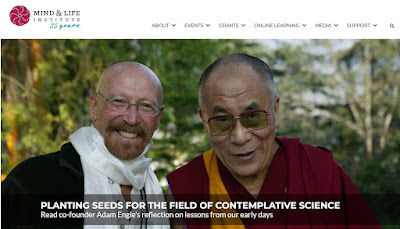
Another series of tweets by Dutch journalist Rob Hogendoorn pointed me to a Youtube discussion between Dzongsar Khyentse Rinpoche/Filmmaker Khyentse Norbu (DJKR) in Conversation with Neuroscientist Dr. Richard Davidson. As Rob Hogendoorn points out in one of his tweets "Dr. Davidson is a Professor of Psychology and Psychiatry at the University of Wisconsin-Madison and heads the Center for Healty Minds". Dr. Richard Davidson is a also a prominent member of The Mind and Life Institute and a good friend of Jon Kabat-Zinn, the inventor of Mindfulness (mindfulness-based stress reduction MBSR), who introduced Dr. Richardson to the Dalaï-lama.
It was at that meeting that my life and my work went through what Jon [kabat-Zinn] has called an orthogonal rotation. The Dalai-Lama was quite forceful and challenging and said that we've been using tools of modern neuroscience to study depression and anxiety and fear, why can't we use those same tools to study kindness and compassion. That was a wake-up call.” (Youtube)

Like good news journalism, positive psychology, self-improvement (Dale Carnegie) and attracting positive things into ones life, some neuroscientists seem to have made it their life’s quest to look into how our lives could be made more positive, which is possible thanks to brain plasticity or “neuroplasticity”. Neuroscientists study neurophenomenology, neuropsychology, neuroanthropology and behavioral neuroscience. Many modern practitioners of religions have high hopes in neuroscience, because, to them, neuroscience looks at the “link” between body and mind (“consciousness”) and could, who knows, prove the existence of “consciousness”, as being different from the body and capable to act independently from the body, even after physical death. Or it can perhaps one day teach us how manipulations on the physical “neuronal”, or “yogic”, level could influence consciousness, beyond its lifetime interaction with the body? A happy marriage between science and faith, why not?

"Your mission is to proceed up the Nung River in a Navy patrol boat"

To religious scientophiles Francesco Varela seems to be the neuroscientist who set the bar highest on the Science-Belief Spectrum (SBS), on the side of science (neurophenomenology). Jon Kabat-Zinn was the first scientist (Ph.D. in molecular biology) to successfully secularize an applied practice of “meditation”. Dr. Richard Davidson goes further down the “Nung river” of cultivating AND measuring compassion, well-being etc. Perhaps one day also emptiness and Bodhi?

Other religious scientophiles approach neurophenomenology from the other side and call their parapsychological effortsNoetic Sciences”. The Institute of Noetic Sciences (IONS) was co-founded in 1973 by former astronaut Edgar Mitchell.
The Institute conducts research on topics such as spontaneous remission, meditation, consciousness, alternative healing practices, consciousness-based healthcare, spirituality, human potential, psychic abilities, psychokinesis and survival of consciousness after bodily death.” (wikipedia)
Europe has its own Institut Suisse des Sciences Noétiques (ISSNOE), founded by Sylvie Dethiollaz, doctor in molecular biology, and supported by French celebrities as Frederic Lenoir, Igor et Grichka Bogdanov, etc. In 2017, Sylvie Dethiollaz could be seen in various TV-shows with her “research collaborator” in Out-of-body experiences, Nicolas Fraisse, who, from a young age onward had the ability to leave his body at will while his mind freely traveled around. The institute investigates resurrectional phenomena and is extremely interested in the Tibetan Buddhist Rainbow body.

Other Tibetan masters such as the Kagyu/Nyingma teacher Yongey Mingyur Rinpoche use the Steiner/Waldorf method for their educational projects with courses such as ‘Child Development from Birth to Rebirth’ (with "Dr Meyrav Mor, Dr Matthieu Ricard, Dr Richard Davidson and others") (see my blog Le réincarnationisme à l’école).

Influenced by and loyal to his father Thinley Norbu Rinpoché[1] (1931-2011) DJKR, defends a conservative traditional Tibetan Buddhism and at various occasions wrote openly against attempts to secularizeBuddhism[2] and integrate Western values such as democracy, rationalism, science. The present discussion with neuroscientist Richard Davidson is therefore surprising, but Dr. Davidson seems ready to go quite far on the belief spectrum to help DJKR to secularize “Buddhism” and the “Science of Meditation”. DJKR thinks that modernization” (“so called modern life”) “is basically a westernization (09:18)”, and that after first going through paganism, Christianity, Enlightenment, Western civilization is now stuck in rationalism [and science] (22:53 “Bodhi TV : An interview with Dzongsar Jamyang Khyentse Rinpoche[1]” 11/04/2021).

In the discussion with Dr. Davidson, there is an agreement about the recognition that “awareness” (tib. rig pa) is continuously with us (0:51), including during dreams. There is no separation in this “awareness”, there are no “bardos” (tib. bar do, intermediate state). There are various intermediate states, states or “momentary gaps” that are intermediate between two temporal limits.
“Davidson: The way I think you've explored in some of your films [ ] that's related to this is death and dying and “bardo”. The way we think of “bardo” as a scientist, it's kind of a gap, a momentary gap, when the normal constraints on our perception are suspended. It even could just be a brief moment, it could be like a sneeze[3], but those are like mini-bardos that provide an opening, where there are other ways of seeing (23:00).

“DJKR: I think what people also need to know is when we talk about in between, we are talking about two things, like this and this, and then in between, the bardo. In teachings it is clearly stated that these two [temporal limits] actually do not exist. This bardo, in between, is just another [state] like an illusion. (24:11)”
In order to be able to meet neuroscience, DJKR does not mention the most famous “bardo” in Tibetan Buddhism, which is the bardo between death and the next rebirth, about which many books have been written, and on which the great majority of Tibetan Buddhist Nyingma teachings and practices are based. If one can have a neuroscientist accept the bardo of the time of a “sneeze” (22:39), then perhaps there is a chance to slip in the “bardo” between death and rebirth… Both DJKR and the Meditation scientist may have in the back of their minds that “awareness” is continuous (immortal?), including during the “bardo” after the death of the physical body.

Dr. Matthieu Ricard and Dr. Richard Davidson

Dr. Davidson seems to regret that the current state of the “Science of Meditation” in the West is only “a small fraction”, “a tiny sliver” of what meditation has to offer, and wants to go further along his research, including by integrating devotion and faith (skt. śraddhā tib. dad pa), “that have received very little study” (9:53). Because:

“Dr. Davidson: devotion is important in developing a kind of confidence, not an arrogance, but a confidence to basically keep going on the path. I think that one of the challenges in the modern dissemination of dharma in the West is that and one of the challenges of using science to help to promote it is the lack of devotion.” (9:26)

DJKR observes that devotion and faith are not enough, because they are a technique, a method, that needs to be associated with a “view” (skt. dṛṣṭi tib. lta ba), otherwise they just float in the air (9:00). A “view” is a doctrine, an ideology… that nicely captures and contends devotion and faith.

The Science of Meditation is in need of devotion and faith in a doctrine for “the modern dissemination of dharma in the West”. Otherwise one can’t make sense of one’s experience in the same way (15:22). Dr. Davidson, the neuroscientist, discussed with the Dalaï-lama about how the “view” could be “conveyed” “in a way that is quote ‘secular’ in a way that could be appealing to everyone, to be more universal” (15:27).

DJKR thinks this is possible, even though the Buddhist “view” “is packaged” in madhyamaka and tantra, which makes it technical, mechanical, philosophical and intellectual, whereas in reality it is so simple (16:14).

As we know, although DJKR has spoken out fiercely against secularism (Stephen Batchelor) and declared repeatedly :
"Under no circumstances should any of us even attempt to change the Vajrayana’s core teachings. By changing just one word, you effectively take on full responsibility for the spiritual path and enlightenment of all future practitioners. I, for one, lack the courage to do such a thing." Poison is Medecin, p.233
Here (13/05/2021) he seems to be ready to allow for a more secular approach, most likely under the condition that the guru keeps playing the key role in the process of helping the student to recognize reality, which can be as simple as folding paper tissues.

The next stage for gray neuroscientists seems to be to also integrate guruvāda into the mix of Science of Mediation.  

***

[1] A son of Dudjom Rinpoché (1904-1987) and author of “Words to the West”, which in its first paragraph declares “Almost all western teachers of Buddhism are either nihilists or eternalists, and not actual Buddhist lineage holders.”

[2] How India Is Squandering Its Top Export: The Buddha, 14/07/2016, Huffington Post, Dzongsar Jamyang Khyentse, Contributor, World-renowned Buddhist meditation master, teacher and author.

Jay Garfield wrote an answer (“In defense of the Secular”) to defend his view of secularism.

[3] In Buddhist and non-Buddhist tantrism, moments and opportunities for awakening include sneezing, yawning, surprise, orgasm, etc. See Dalaï-lama, The World of Tibetan Buddhism, 1995, Wisdom Publications.

vendredi 11 mars 2022

Folding paper tissues and enlightenment

The Nepalese journalist of Bodhi TV and DJKR esxplaining how to serve the guru

I was made aware of the video “Bodhi TV : An interview with Dzongsar Jamyang Khyentse Rinpoche[1]” (11/04/2021) through a tweet by Rob Hogendoorn. It does indeed expose nicely DJKR’s mystifying strategy. DJKR is a reincarnated hierarch (tulku) of the Tibetan Nyingmapa sect. Together with other Tibetan Buddhists hierarchs, he came out definitively as a fundamentalist in the aftermath of the Sogyal/Rigpa scandal in the summer of 2017, where he made a tour defending “Vajrayāna” Buddhism and the master-disciple relationship (skt. guruvāda) associated with it. Although he is a Vajrayāna master himself, he will use the doctrines of other Buddhist “vehicles” (skt. yāna) if it is convenient. This is possible because of the triyāna and “Three sets of Vows” (tib. sdom gsum) approach of Vajrayāna Buddhism, that sees itself both as the highest vehicle of Buddhism, while integrating doctrines and practices of the lower ones. In this way DJKR can use ad hoc arguments of any of the three vehicles, to suit his needs. He is far from being the only TB lama to do so…

Since the esoteric Buddhism of Vajrayāna, and the “Gnostic” practices of Tibetan Dzogchen are the most difficult to defend to a rationalist, skeptic and materialistic Western audience, DJKR and other lamas will very often fall back to the arguments of the lower Buddhist vehicles to defend Buddhism as a whole. The “lower” Buddhist vehicles were tougher on “superstition” than esoteric Buddhism, that embraces it wholeheartedly (and ideally skilfully…), and have more arguments to present a more “rational” side of Buddhism to a Western audience. Anyone following Vajrayāna Buddhism, that may be considered as having a “Single vehicle” (skt. ekayāna) approach (see the Lotus Sūtra), may start with doctrines and practices of the “lower” vehicles, but will inevitably at some point end up with the “highest” practices of Vajrayāna Buddhism and/or Tibetan Dzogchen, of which DJKR is one of the best known teachers in the West.

This being said, let's have a look at the discussion between the Nepalese journalist Bhusita Vashista and DJKR.

For DJKR “modernization” is a threat to spiritual life, because “modernization” (“the so-called modern day”) “is basically a westernization” (09:18), and Western “intellectuals” bundled Buddhism “into this superstitious religion” (08:58). In order to prove that “Buddhism” is not a superstition, DJKR will go back to the “lowest” Buddhist vehicle to use its teachings on the certainty of death, impermanence and constant change, etc. in order to show how rational “Buddhism” is. If one realizes that “practically, not just intellectually” (10:36), then that’s “enlightenment”, or “satori”, or “nirvāṇa”, or in Tibetan “bden pa mthong ba”, “seeing the truth like it is[2].

That simple. It may seem to the non-initiated that DJKR is “anti-West” (12:50), but he isn’t, he likes jazz and church music and many other things. But the Western way of thinking differs from the Himalayan approach. One can’t expect a bear (Himalayan) to behave like a monkey (Westerner) (13:50). E.g. when a Westerner asks a Tibetan lama what is the purpose in life, then he is asking a question from a Christian point of view (15:06), which is not at all relevant in a Himalayan context. Also, the Tibetan language doesn’t even have a word for “good” and “bad”... (14:23). Western translations of Buddhist terms hardly ever cover the load. “Compassion” is so different from “karuṇā” (skt) and “snying rje” (tib)... If one is blinded by those words and concepts, without seeing their “spirit”, one tends to become arrogant and righteous (17:16). That would be like looking at the finger pointing to the moon rather than at the moon itself.

Here, DJKR skips to Mahāyāna doctrine. All the richness of Buddhism with its “opinions”, [“superstitions”], disciplines, rituals, monks shaving their heads and begging, these are just “fingers” pointing at the moon. The moon is simply “seeing the truth” (18:22). All those “fingers” are like teddy-bears that are skillfully used to draw the attention of toddlers about to fall from a cliff and thus to save them. DJKR is referring to the Lotus Sūtra and its parable for the necessity to save all sentient beings (toddlers) from the burning house that is saṃsāra. This sounds very dramatic: all sentient beings are in danger, like toddlers on a cliff, and need to be saved by all means, even if that implies to trick them for their own best. But all it needs for these toddlers to be saved is for them to realize that life, things and themselves change and are impermanent, “seeing the truth”, as DJKR said himself, in hīnayāna mode, at the beginning of the interview.
When you know this not only intellectually, but actually, you are freed from being brainwashed. What more do you want? Enlightenment to those of you, like a golden color, the things that we see, you know buddha, all that you know, the light, those are teddy bears. Those have functions, but everything we are discussing cannot be conceived and understood by everyone, so you need rattling toys to distract the babies, of which there are many. So we have temples, prayer wheels and gates, and music and all of that, which is fine, we just need to know that they are all fingers, they are not the moon.” (18:45)
Apparently, it is easier “to see the truth” (tib. bden pa mthong ba”) for the hoi polloi through all the “rattling toys” and “teddy bears” than through the simple experience that life, things and individuals change and are impermanent…
I would say 99,99% of the Buddhist path is like this teddy bear” (07:40)
99,99% of “brainwashing”, “fingers” and toddler pedagogy, to try and make sentient beings understand that life, things and individuals change constantly and are impermanent, in other words “to liberate them”. Western and Eastern “rationalists” qualifying the “teddy bears” as superstition would make them partly responsible for the death of all the toddlers falling from the cliff...

For “compassion”, DJKR turns to the Mahāyāna Nālandā Buddhism of Nāgārjuna and Candrakīrti : “the real compassion is when you see the truth” (15:46), this time termed "non-duality": “you know something is there, but at the same time is not there. Everything's like a rainbow and that is the truth” (15:57). “So-called compassion” like morality, ethics, generosity, will only make one more righteous, proud and dogmatic (17:13).

As for values like social justice, democracy, etc. they’re just equally bad and good as any other system (21:07). The Western civilization went through paganism, Christianity, Enlightenment, rationalism and stopped short there (22:53). But early on, the Buddhists (with śūnyatā) were already skeptical of rationalism and “so-called logic”, that doesn't go beyond opinion.

As for reducing Buddhism to the lower yāna method of śamatha and vipaśyanā, BTW nowadays “watered down to just sitting, breathing and relaxing”, to rid oneself of stress, which “is absolutely wrong in Buddhism” (25:12), it won’t help to “see the truth” (as defined above).

DJKR has expressed himself often about how Buddhism, Vajrayāna, can’t be changed, otherwise it wouldn’t work, but he makes an exception for Buddhist art (tib. sgyu rtsal), something fake that helps to get the truth across. The Buddha often said that to see his physical or formal body was not to see the Buddha. Those who do were said to have a “wrong view” (28:10). DJKR, also a movie director, recalls the aniconic representations of the Buddha in early Buddhism, “but you know, medium has to be changed”. Art, something fake and artificial just like 99,99% of Buddhism, helps to get a/the truth across. Only "intellectuals and scientists” don’t get that, and talk about “superstition” (33:07).


My take: Everybody knows what art and fiction are and what role they play. Yes, they can help to get “a truth” across, but “the truth” ? 

When asked, what “the truth” beyond art is and what exactly art is supposed to be pointing towards, like a “finger”, DJKR gets lost in mystification and refers to the mantra of the Heart Sūtra : “gate gate pāragate pārasaṃgate bodhi svāhā”. The four times “gone” (gate), including the “forgone” and “gone beyond” (33:56). “Quatre petits tourset puis s'en va”, the French would say. I suppose an English equivalent could be “Here we go 'round the mulberry bush”, or “Here we beat 'bout the mulberry bush”...

At the end of the interview, DJKR talks a bit about tantrism or vajrayāna, and the passions (skt. kleśa) being the footprints of wisdom (37:24). By just following these footprints, one finds peace. In his answer to the question (“are you enlightened?”, “do you know ‘the truth’”), the reincarnated hierarch DJKR says he knows “some”, which has saved him a lot. He then turns back again to the Buddhism of the lowest yāna. This truth is the truth DJKR mentioned in the beginning of the interview: death and impermanence. The fact that he thinks everyday about death makes him a more enlightened man than someone like e.g. Trump or Biden.

Bhusita Vashista asking her question

In her last question Bhusita Vashista wants to know whether there is a way out of “ignorance” without following a guru. The “guru business” is exclusively tantric explains DJKR, but when one speaks about “organized religion”, one is not really strictly speaking about tantrism (48:10). The fictional hagiography of Tailopa and Nāropa is once again called to the rescue to show what is supposed to happen in this tantric relationship. Although these masters were princes, accomplished pandits, abbots of Nālandā, they ended up being fed up with rationalism and logic etc., and had to get out of there to meet secretly with prostitutes, arrow makers and receive teachings from them.

When you talk about organized religion [...] you are not really talking about tantric Buddhism

DJKR gives an example of this privileged relationship. A guru like DJKR could suggest to his skeptical disciple to go to Bhaktapur (Nepal), fold a paper tissue there and come back again. Doing something meaningless ("bullshit job"?) like this during a week or so is supposed to teach one to do things without a purpose, without hope and fear, and provides the disciple with a sense of bliss… DJKR gives a very innocent example here, remaining silent on TB teachers asking students to do the things that they “dislike doing the most”.

For the greatest appeal to a Western audience, DJKR and others turn to basic Buddhist ideas: the first noble truth, death and impermanence, in order to develop detachment. For skepticism Nāgārjuna is called to the rescue, for “compassion” Mahāyāna Buddhism and the Lotus Sūtra. But apart from retelling the story of Tailopa and Nāropa, we haven’t learned much about the exact role tantrism and guruvāda play in learning "the truth", or “some of the truth” about and through death, impermanence and emptiness. Apart from doing meaningless things for the guru like folding paper tissues. If it’s not really about tantric Buddhism, or Buddhism for that matter, then what is this all about?

"Every outing, every task, every gesture must be prepared in advance by the dakinis. During these morning outings on the hill of Lerab Ling where [Sogyal Lakar”] "sits", or during walks in nature, the dakini must prepare his bags in advance following the instructions of a manual: the least outing requires 2 bags containing 6 handkerchiefs (Kleenex folded and presented in a certain way required by the master: they are useful for him to blow his nose and to wipe his sex after having urinated; If this is done in the wild, the dakini must wait behind him until he has finished, he wipes himself and hands the used Kleenex to the dakini so that she throws it in a plastic container provided for this purpose), his Tibetan medicines, his comb, his back-scratcher, his shoehorn, 1 mini-teapot, pens, 1 notepad 1 T-shirt and a change of underwear, 1 banana, cookies, 1 bottle of water, his "practice" CDs, 1 CD player, his 2 cell phones, Lerab Ling's landline phone, 1 shawl, Olbas Oil (nasal decongestant), 1 voice recorder, 1 iPod with his prayers, headphones, sunglasses, 1 umbrella. On the platform set up on his hill, he stays about ten minutes to meditate. To prepare this event, two people must run behind him to bring in time cushions, a bowl of soup, water, glasses, screen, install the audio equipment so that he can listen to his prayers, a notepad on his tablet ... Still according to Mimi, the master has a lot of trouble to remain still during his "sitting".”[3]

Translated (DeepL) extract from Les dévots du bouddhisme, by Marion Dapsance

***  

[1] For information on DJKR, I would recommend Matthew Remski’s blog “The Edgelord Lama Dzongsar Khyentse Rinpoche shitposts his way through #metoo” (06/07/2021).

[2]So if we are talking about that level, that kind of satori, which is a Japanese word, or nirvāṇa, liberation, you know in tibetan we call it “bden pa mthong”. “bDen pa mthong” means seeing the truth it's like.” (11:41)

[3] « Chaque sortie, chaque tâche, chaque geste doit être préparé à l’avance par les dakinis. Lors de ces sorties matinales sur la colline de Lerab Ling où il « s’assoit », ou lors de promenades dans la nature, la dakini doit préparer ses sacs à l’avance en suivant les instructions d’un manuel : la moindre sortie nécessite 2 sacs contenant 6 mouchoirs (Kleenex pliés et présentés d’une certaine manière exigée par le maître : ils sont utiles pour qu’il se mouche et pour essuyer son sexe après avoir uriné ; si cela se fait dans la nature, la dakini doit attendre derrière lui qu’il ait terminé, il s’essuie lui-même et tend le Kleenex usagé à la dakini pour qu’elle le jette dans un plastique prévu à cet effet), ses médicaments tibétains, son peigne, son gratte-dos, son chausse-pied, 1 minithéière, des stylos, 1 blocnotes, 1 T-shirt et 1 slip de rechange, 1 banane, des biscuits, 1 bouteille d’eau, ses CD de « pratique », 1 lecteur CD, ses 2 téléphones portables, le téléphone fixe de Lerab Ling, 1 châle, de l’huile Olbas Oil (décongestionnant nasal), 1 enregistreur vocal, 1 Ipod comprenant ses prières, des écouteurs, des lunettes de soleil, 1 parapluie. Sur la plateforme aménagée sur sa colline, il reste dix minutes environ à méditer. Pour préparer cet événement, deux personnes doivent courir derrière lui pour amener à temps coussins, un bol de soupe, eau, lunettes, paravent, installer le matériel audio pour qu’il puisse écouter ses prières, un bloc-notes sur sa tablette… Toujours selon Mimi, le maître a beaucoup de mal à rester immobile pendant son « assise ». Les dévots du bouddhisme, by Marion Dapsance